Why Y’all Hatin’ on Witch Lezah?

As we reach the midway point of The Looney Tunes Show‘s sophomore season, I’ve noticed the hate rants and complaints about the show have diminished considerably. No doubt this is partly due to how the writers and artists have actually listened to viewer complaints about the show and have adjusted things accordingly: they’ve abandoned Jessica Borutski’s original stylized character designs in favor of a more ‘classic’ look, they’ve switched to brighter colors (Bugs is gray again instead of pale lavender!), the writers have upped the slapstick and the visual gags, there are more callbacks to the original shorts, and in general things have just gotten ‘loonier’. (Of course, we still haven’t seen much of Elmer Fudd, the Road Runner and Wile E. Coyote segments are gone and the Merrie Melodies are on the way out with the departure of Ms. Borutski, but no show is perfect.)

However, it’s not all hunky-dory in the Looney Tunes ‘hood; despite the improvements the show has made, there is one element of TLTS that still continues to raise peoples’ ire. Namely, this lady:

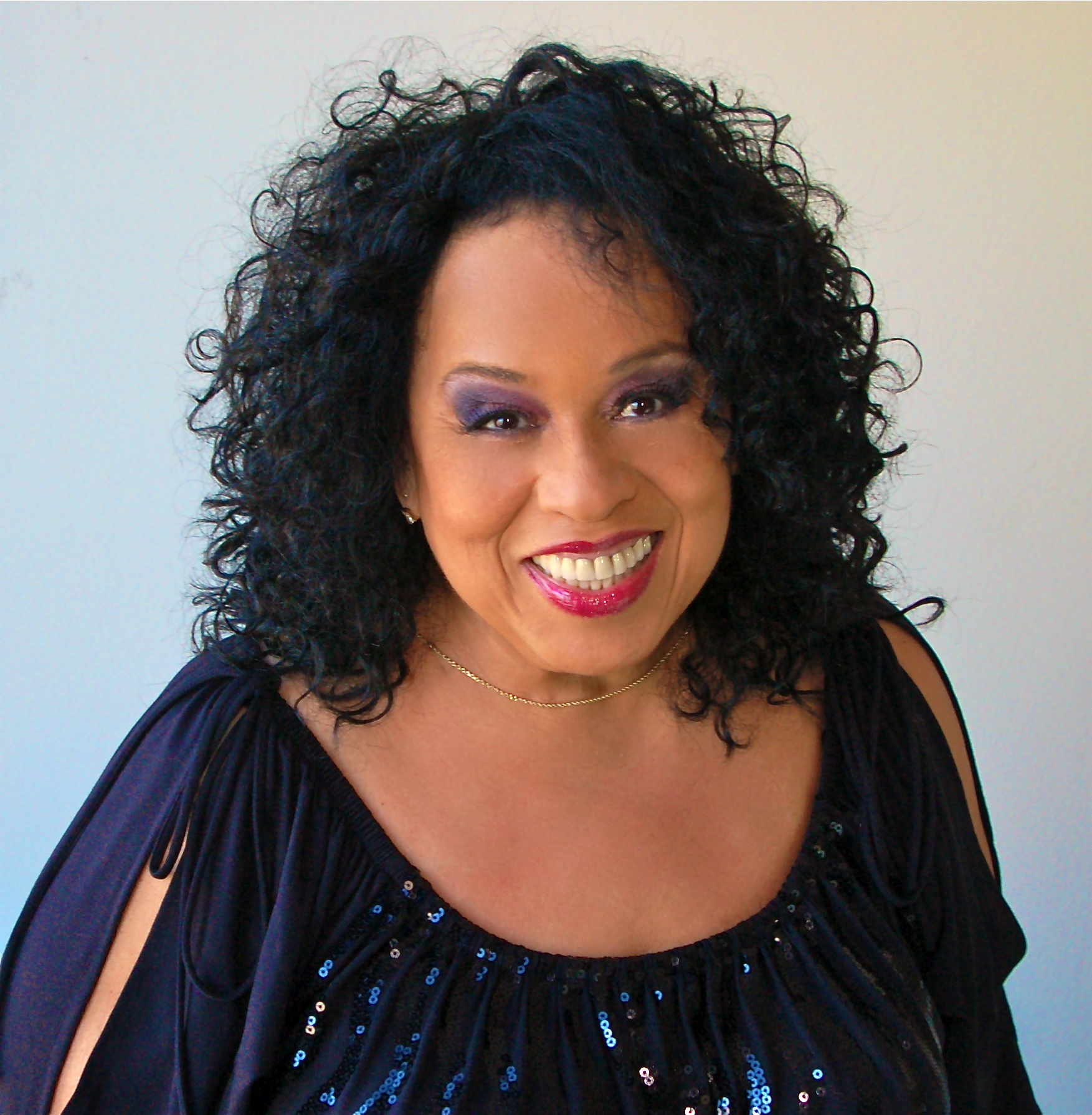
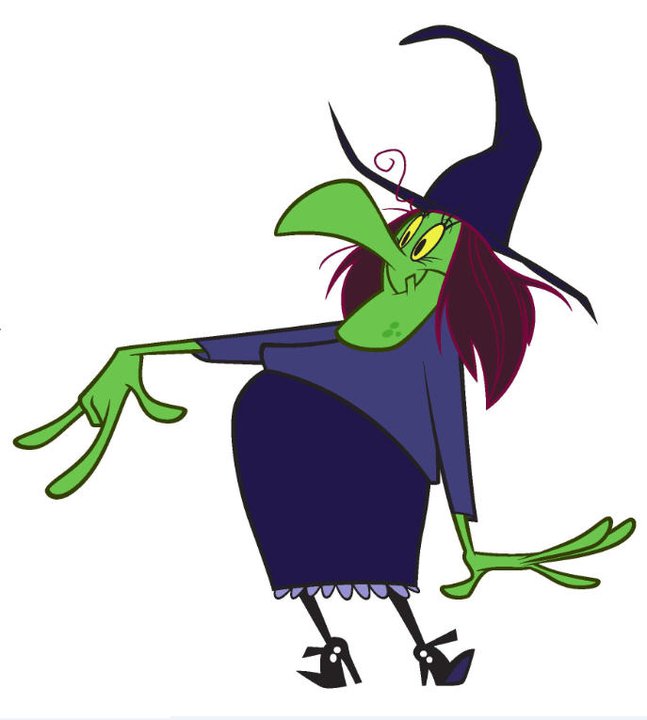
 This harbinger of evil, this blight upon the community, is Witch Lezah, the fun-house mirror version of Bugs Bunny’s Looney Tunes adversary Witch Hazel, here cast as Bugs and Daffy’s no-nonsense witch neighbor and single mother to little boy inside the body of a 9-foot tall giant orange monster Gossamer, voiced by African-American stage, film and TV comedienne and actress Roz Ryan.
While a secondary character on the show itself, there is a surprising amount of hate and derision aimed at this character. The biggest irate questions asked about the Witch are: why is she called ‘Lezah’ instead of ‘Hazel’? Why does she sound black? and Why isn’t June Foray voicing her, especially when June Foray is on the show voicing Granny? One colleague of mine who’s a member of both The Big Cartoon Database and the place I recently moved out of, Toon Zone, is one of Lezah’s biggest detractors, never passing up an opportunity to cast stones at the character and her voice actress. His favorite smack against the character is to call constantly (and I do mean constantly) compare Witch Lezah to Mammy Two-Shoes, the Buelah-esque black maid featured in the early Tom & Jerry cartoons, referring to Lezah as “The Mammy Two-Shoes Witch” and accusing the character of being “an offensive stereotype of a black woman”. His favorite comment (which he’ll spout at the drop of a hat) is: “I think if they decide to bring Mammy Two Shoes back to Tom and Jerry, Roz Ryan would be the perfect voice actress for her.”
Now, I like and respect this guy; he’s a little candid with his views, but he often offers intelligent observations backed by facts and reason, and he does his research so he knows a lot about the animation industry and the people behind it, so I can respect most of what he has to say, which is why I didn’t preface his comments as a Point and Laugh, however, I couldn’t disagree with him more about Witch Lezah. I’ll save my views on his points for later, right now allow me address the other questions people keep asking about the Witch:
  • Why is the Witch called ‘Lezah’ instead of ‘Hazel’?
  • Why does she sound black?
  • Why isn’t June Foray voicing her, especially when June Foray is on the show voicing Granny?
I’ll answer these in reverse order. First, as to why June Foray isn’t voicing the Witch, well, that’s another elephant in the room that no one wants to acknowledge, but that’s kind of what we do here. Namely, that as of this writing, June Foray is 95 years old. 95. No one wants to face that, but the woman is pushing a century. It’s very possible (and quite likely) that Ms. Foray no longer has the energy and stamina to perform such a lively character anymore, and also WB probably doesn’t want to give Ms. Foray a lot of work to do because it’s not known how much more time she has on this dimensional plane. Note how Granny has been a tad more subdued than her early shorts appearances, and note also how Granny as yet hasn’t had any speaking roles since season 2 started. Regarding why Lezah sounds black, that’s because she’s voiced by an African-American woman, Roz Ryan.
Roz_Ryan_8
Regular viewers probably recognize Ms. Ryan as the voice of Bubbie the whale on The Marvelous Misadventures of Flapjack. She also voiced Thalia, the Muse of Comedy on Disney’s Hercules (1997). She has also voiced Cake on CN’s Adventure Time and Wade’s mom on Kim Possible. Among her live-action appearances have been NBC’s Amen (1986-1991), Barbershop (2005), General Hospital (2012) and The Rickey Smiley Show (2012).
As for the name change, I’m guessing that was implemented because LT purists wouldn’t accept anyone else other than June Foray voicing Witch Hazel (though it’s worth mentioning that in Hazel’s first shorts appearance, Bewitched Bunny, she was voiced by Bea Benederet), so the producers established her as a different character altogether, by simply switching the name around–‘Lezah’ is ‘Hazel’ backwards. (Another question I’ve heard more than once is: is there any connection or relation between Witch Lezah and Witch Hazel? I once read on Wikipedia that in-universe Lezah is supposed to be Hazel’s sister and that Witch Hazel herself was supposed to appear on a Halloween themed episode sometime during season 2. Of course it’s worth mentioning that this was posted on Wikipedia, which anyone and their Aunt Gertrude can edit, and said information was promptly removed shortly thereafter, so my guess is that this was nothing but an unfounded and groundless internet rumor.)
Now, on to my friend’s Mammy-Two Shoes analogy. Yes, Lezah’s voice and mannerisms are indeed based on those of a stereotypical Black American woman, but I don’t see this as an offensive ethnic stereotype so much as the writers intentionally basing the character’s persona around that of the actress who provides her voice. Lezah is more or less an animated version of the characters Ms. Ryan typically portrays on TV and movies. It’s no different from how Donkey from Shrek and Iago from Disney’s Aladdin were modeled after their voice actors, Eddie Murphy and Gilbert Gottfried respectively. Now as an African-American, I’m usually the first to point out when something is racially offensive, and I’m not the least bit offended by Roz Ryan’s Witch Lezah, however I do get kind of miffed at my fellow poster’s constant Mammy Two-Shoes comparisons. Is Lezah a tad stereotypical? Yes, no denying that. But I think calling her a Mammy Two-Shoes throwback is taking it a tad too far. And maybe Ms. Ryan could possibly voice MTS, but I can assure  you that a return of Mammy Two-Shoes to the Tom & Jerry-verse is NEVER going to happen. You can file that right alongside of Disney ever releasing Song of the South on DVD in the Never Gonna Happen bin. Now I don’t hate the character of MTS; I can tolerate her appearance in the old T&Js fine, as long as one takes into account when these cartoons were made. African-American women working as domestics for white families were fairly commonplace during the 1930’s through the 1950’s, so such caricatures weren’t considered racially offensive at the time. But a character like MTS would never fly with a contemporary audience today, society has changed far too much for such a character to be socially acceptable in any medium. In fact, the character has recently resurfaced on WB’s Tom & Jerry Tales as the Caucasian Mrs. Two-Shoes, who is clearly the owner of the house and not just a domestic. You’re not going to see Mammy Two-Shoes anywhere ever again, any more than you’re ever going to see Buckwheat on TV again, definitely not the “Otay!” version of Buckwheat, not unless Eddie Murphy decides to start playing him again.
So I say lay off of Witch Lezah, and lay off of the criticism of Roz Ryan voicing the character. Nobody had a problem with Ms. Ryan voicing a short fat Muse or a blue whale, so why take issue with her voicing a green witch?

Pets Over Ponies (You Heard Me Right)

Brace yourselves, Bronies, I have an announcement that may just shake the very foundation of the world you live on. Here it is:

I think there’s another show on The Hub that I like more than My Little Pony: Friendship is Magic.

T’is true.
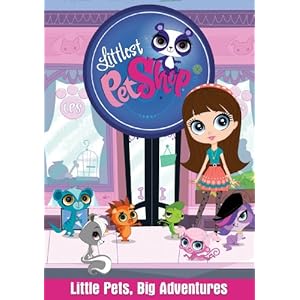
Of course, anybody who regularly follows this blog or my posts on either if the 2 message boards I’m currently on already knows that MLP: FiM wasn’t my favorite Hub show to start with–The Aquabats! Super Show! currently holds that title (it’s supposed to be starting its’ 2nd season sometime this spring–can’t wait!) and I also enjoy Dan VS. to a point, though I think it tends to get a little Pinky & The Brain repetitive and the characters aren’t especially likable (and don’t get me started on the horrible scheduling). The Ponies’ show used to be a close third, but recently another show has risen to challenge MLP for its’ bronze medal. The show in question? Littlest Pet Shop.
First, a brief history lesson (a.k.a., the boring stuff you need to know):
Hasbro manages the intellectual properties of both Blythe (a fashion doll originally released in 1972) and the Littlest Pet Shop toy line (introduced in 1992). Originally held by Kenner Products, both were transferred to Hasbro, years after acquiring most of Kenner’s assets.
As of November 2012, two modern incarnations of Blythe are on sale: One, introduced in 2001 as a standalone toy line, is managed by Tomy (after merging with the original licensee Takara in 2006) and CWC (both companies licensed from Hasbro), sold in parts of Asia, and marketed towards collectors. The other, marketed towards children that was released in 2010, is managed by Hasbro as a part of their 2004 incarnation of Littlest Pet Shop, known as Blythe Loves Littlest Pet Shop.
The series was first green-lit in 2011. During production, Blythe Loves the Littlest Pet Shop was also used by Hasbro as the working title of the TV series. The production staff of the series includes developers Timothy Cahill and Julie McNally Cahill of My Gym Partner’s a Monkey fame, along with Dallas Parker and Joel Dickie. Writers M. A. Larson and Cindy Morrow, who previously wrote episodes of My Little Pony: Friendship Is Magic, also wrote the scripts for the episodes of this series. The songs and music of the entire series were composed by Daniel Ingram and Steffan Andrews.
-OK, with that out of the way, here’s an overview of the show.
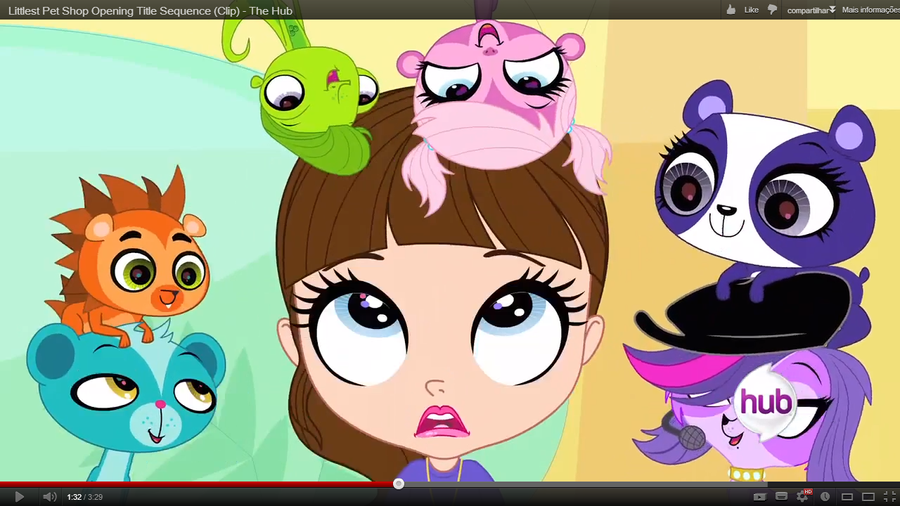
Blythe Baxter is a teen/tweenage (her exact age has yet to be revealed, but I presume she’s somewhere around 12 to 14) aspiring fashion designer (you can tell she’s a little fashionista because she sports a different hairstyle and outfit in each show, she is a fashion doll, after all) who’s cheerful, loyal, always tries her best, is cute, sweet and always willing to help others, though she’s a little mishap and comical misadventure-prone. Blythe and her requisite oblivious and embarrassing goofball father, airline pilot Roger Baxter (Blythe’s mother is MIA, but more on that later) move from their home in the suburbs to an apartment in Downtown City, a fictionalized version of New York City, only much cozier and without the crime, poverty, graffiti, gang violence and urban blight. Said apartment just happens to be located above a small pet shop, called appropriately enough, Littlest Pet Shop, a day camp for pets of all kinds. After hitting her head after riding down a dumbwaiter in one of those aforementioned wacky escapades, Blythe discovers she has somehow broken the communication barrier between man and animal, meaning that she can now communicate with animals and when the pets talk to her, it comes out as perfectly understandable English instead of unintelligible critter-speak which is how it sounds to everyone else. Blythe gets a part-time job working in the shop and assisting the shop’s owner, the delightfully dotty Mrs.Twombly. This newly forged alliance leads to all sorts of crazy fun. The pets themselves are a unique and colorful (as in not always typically found in nature) bunch; each one has their own quirk, talent, passion or obsession that he/she specializes in:
pet1
  • Zoe Trent is a purple Cavalier King Charles Spaniel (of course she’s no mere dog) whose passions are singing and looking fabulous. She’s a full-tilt diva (she even wears a hat).
  • Vinnie Terrio is a deep-voiced and somewhat thick Northland Green Gecko whose passion is dancing. He’s got some moves, though his routines often end with him flat on his face. (Give yourself a gold star if you noticed how Vinnie shares a surname with 70’s Dance Fever host Denny Terrio, the man who supposedly taught John Travolta how to dance.
  • Penny Ling is a small, super-cute, somewhat shy and very girly female white and purple Giant Panda who is a rhythmic gymnast. She is talented with twirling ribbons but is hyper-sensitive, falling to pieces so fast that onlookers risk getting hit by the shrapnel.
  • Minka Mark is a hyper and somewhat spazzy pink Spider Monkey talented in abstract art, which mainly involves splattering paint all over the canvas (hey, it worked for Jackson Pollock). She’s easily distracted by shiny objects, food and pretty much anything else.
  • Pepper Clark is a fast talking and shtick loving grey-and-white skunk whose passion is comedy, largely of the custard pie and floppy shoe variety. She also has the unique ability to alter her scents from pleasant to repugnant, depending on what the situation calls for and/or how funny it is.
  • Sunil Nevla is a timid and neurotic Indian accented teal-blue colored banded mongoose whose aspirations are parlor magic and psychic abilities, which he practices with more enthusiasm than polish. (He reminds me a bit of Raj from The Big Bang Theory, only Sunil’s able to talk to girls).
  • Russel Ferguson is an intelligent and organized orange-brown hedgehog (no, he’s not the fastest thing alive!) who’s the brains of the group. He’s a little uptight and overly meticulous, but lets loose once in a while.
In addition to her adventures with the Pets, Blythe also has her own stories revolving around her trio of friends from her new school: Sue Patterson, the jock, Youngmee Song, the brain, and Jasper Jones, the boy. She also has to contend with the requisite snooty rivals, twin sisters Whitney and Britney Biskit, your garden variety rich shallow preps obsessed with fashion and who punctuate their sentences with “like”s, whose dad own the city’s rival pet store, Largest Ever Pet Shop. The Biskits are easily the most cliched and tiresome characters on the show, but thankfully, they don’t appear every week.
Each episode typically consists of an A plot and a B plot running simultaneously, and the 2 plots occasionally intersect. The designs on both the pet and human characters alike are big on cute, with all of the characters sporting huge eyeballs and large heads, and the show is also peppered with pop songs.
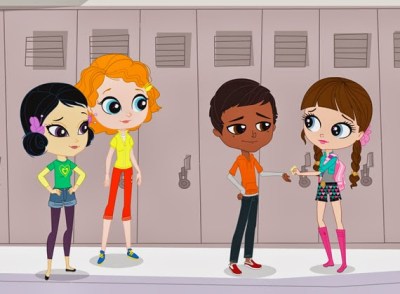
OK, I know what you’re thinking: you like THIS more than the Ponies? Well, I have to say yes, I do. Why? For one thing, LPS actually has people in it. I know that’s superficial, but I tend to gravitate more towards shows with human protagonists and all or mostly human casts. On that note, another reason I like LPS is because the animals act like and are treated like, well, animals. The Pets talk (to Blythe, anyway) and occasionally walk like humans, but for the most part they remain close to the real animals they supposedly represent. The Pets occasionally don scraps of clothing and the like, but the anthropomorphism is never carried to the creepy extremes like it is on shows like Arthur. This works for someone like me, who’s not a huge fan of anthropomorphism, at least not when it’s overdone. Another reason why I favor  LPS is because it has no pretense or delusions of grandeur; it doesn’t try to be anything more than what it is: a cute little toyetic comedy cartoon. It never tries to do anything grand or epic like MLP frequently does, particularly at the beginning and ending of each season. There are no magic kingdoms on LPS, but there’s plenty of slapstick to be had. For anyone who wonders or wants there to be some deep analysis behind Blythe’s newfound power or some major ramifications thereof, I would refer you to the last verse of the Mystery Science Theater 3000 theme song: “Just repeat to yourself ‘It’s just a show, I should really just relax’.”
While most of the characters on LPS are appealing and the stories cute and entertaining (and Mrs. Twombly gives the performance of a lifetime), it’s not all gravy. I do have some gripes with the show. For one thing, the Pets flit around the screen so rapidly that it’s hard to keep track of them all at times, though this is becoming less of a problem as episodes progress. Also, I’d like to see Blythe’s friends do a little more; as things stand currently they’re little more than props for the most part. And it’s clear to me that the writers don’t really know what to do with the Biskit Twins. Aside from how their characters generally don’t make any sense (they’re more super-rich kids who slum it with the ‘regulars’ in public school for no logical reason), they don’t work as antagonists for the simple reason that they have no reason to antagonize Blythe other than they’ve been designated as the show’s villains. Yeah, their dad owns the rival shop, but this is barely touched upon in the show and since the Twins don’t give a wet slap about work anyway, it makes no difference. Since they’re ineffective as baddies and it’s clear that the writers don’t want them to be buds with Blythe and company, they just have these characters around but really don’t know what do with them. I know it’ll never happen, but I’d like to see them transfer to a private school or otherwise pull a Houdini at the end of the season.
But by far my biggest complaint about the show concerns Blythe’s mother, namely she has none. Is she alive? Is she dead? Divorced? Where is she? There’s absolutely no reason for Blythe’s mom to be a no-show. While I hate that they also employ the Missing Mom trope on Transformers Rescue Bots, I at least understand why they do it on that show: because it’s aimed primarily at young boys, and few boys would willing buy a Transformers toy piloted by a mom; they probably only have girls on TRB because they’d get in trouble with feminist groups if they didn’t. (It’s also worth mentioning that Cody’s friend Frankie on the show doesn’t have a mother either. So what’s your beef with moms anyway, Hub, you mother-hating pricks?!)
But those little nitpicks aside, I can still enjoy Littlest Pet Shop. It is my hope that the show will thrive, find its’ own audience and finally break out of My Little Pony‘s shadow. Just let it do what it does, and wash over you like a warm mist. It won’t change your life, but it’ll keep you entertained for a half-hour.

Player Two Start!: Wreck-It-Ralph: Stuff You May Have Missed

It was a good summer to be a gamer.
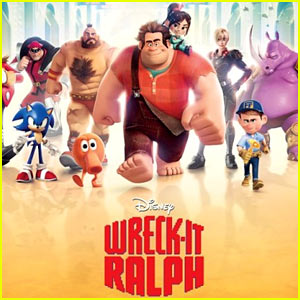
Disney’s Wreck-It-Ralph, the story of a big, burly but lovable video game villain (voiced by Walk Hard/Stepbrothers/Check It Out! with Dr. Steve Brule comedian/actor John C. Reilly) who just wants some respect and ends up getting so much more, earned an estimated $130,248,000 in North America, and $35,700,000 in other countries, for a worldwide total of $165,948,000. In North America, the film debuted with $13.5 million, an above-average opening day gross for an animated film released in November. During its opening weekend, the film topped the box office with $49 million, marking the largest debut for Walt Disney Animation Studios, ahead of Tangled‘s opening ($48.8 million).
I myself am an extremely casual gamer (I probably play an average of 1 or 2 games per year, though I watch a lot of game reviews and am a regular viewer of The Game Overthinker), but my general video game illiteracy didn’t prevent me from enjoying this movie. So far, I’d say that Wreck-It-Ralph is probably my 2nd favorite movie of 2012, topped only by The Avengers, and given how there are already Wreck-It-Ralph toys and tie-ins, Ralph himself cameos in the latest Sonic the Hedgehog racing game and costumed mascot versions of Ralph and Vanellope Von Shweetz (the ‘glitchy’ star of neighboring racing game Sugar Rush voiced by comedienne Sarah Silverman) have already been planted at Disney theme parks, it’s safe to assume that others enjoyed it as well.
I’m not going to review the movie itself, as I generally don’t do film reviews, since there are already dozens of people on the internet who do movie reviews and all of them do it 20 times better than I would, however I will list some of the ‘hidden’ bits, allusions, trivial facts and character cameos that were sprinkled throughout the film. Director Rich Moore determined that that for a film about a video game world to feel authentic, “it had to have real characters from real games in it”, thus Wreck-It-Ralph and his pixelated brethren inhabit their own world within the arcade, interconnected by a massive hub known as Game Central Station. GCS is brimming with a galaxy of characters and idioms from the gaming world, so there are a lot of things that you may have missed the first time. (I didn’t spot all of them right away, either).
First, the obvious facts about the fictional games within the movie:
  • Ralph’s game, Fix-It-Felix Jr., is a homage of 8-bit classic arcade games such as Donkey Kong. The story of Fix-It-Felix Jr. not only establishes Ralph’s counterpart Felix as the resident “golden boy” hero of the game, but also helps the movie audience identify and sympathize with Ralph: the game’s into depicts Ralph as a giant-sized backwoods yokel who’s living peacefully in a stump on his own property, when a deluxe luxury apartment is constructed around him, forcing Ralph off his land and into the junkyard just to the right of the screen. Enraged, Ralph proceeds to climb to the top of building and demolish the place from the roof down with his bare hands (“I’m gonna wreck it!”). This brings in the hero of the game, Fix-It-Felix Jr. (voiced by 30 Rock‘s Jack MacBrayer), the building’s beloved superintendent, armed with a magic golden hammer that can repair anything with just a tap, to fix the damage that Ralph wreaks (I can fix it!”). In the game, Felix hops and jumps across the building’s ledges a la Mario (fun trivia fact: Mario’s original name was Jumpman).
  • The first game Ralph ‘game jumps’ to, Hero’s Duty, is a grim, dark, edgy and violent First Person Shooter (FPS) in the mold of games such as Halo and Call of Duty, with some traces of Metroid. The main character of Hero’s Duty, Sgt. Calhoun (voiced by Glee‘s Jane Lynch) is not only reminiscent of Ripley from the Alien movies, but she may also be a sort-of homage to Metroid‘s Samus Aran, who likewise wears a high-tech suit of armor. (At the end of the original Metroid for the NES, if the player defeated the entire game on difficult, then Samus’ armor would disappear, revealing Samus to be a woman.)
  • The second game Ralph jumps to (and where he meets Vanellope), Sugar Rush, is a mix of the popular children’s board game Candy Land and the Super Mario Kart racing game series.
Now, some of the more obscure stuff:
  • The song “Wreck It, Wreck-It-Ralph”, performed over the movie’s closing credits, was composed by the duo of Buckner & Garcia, the same pair who wrote “Pac-Man Fever” back in the 1980’s.
  • The theme song for Sugar Rush, also heard over the closing credits, was performed by an actual J-Pop band, AKB48.
  • Speaking of music, real life dubstep musician Skrillex makes a non-speaking cameo in the movie; he’s the DJ at Felix’s 30th anniversary party.
  • At the movie’s opening, in Litwak’s Arcade, one of the game cabinets seen is the original Teenage Mutant Ninja Turtles arcade game.
  • After Litwak’s closes, the character who announces that all is clear is Yuni Verse from Dance Dance Revolution.
  • The bar that Ralph visits after the party scene is Tapper’s Tavern. Tapper is an old arcade title from the early-to-mid 80’s, in which the player controls a bartender whose goal is to slide mugs of beer over to his patrons.
  • The chef seen in the kitchen of Tapper’s Tavern is Peter Pepper, the main character of the 80’s video game Burger Time.
  • One of the items that Ralph finds while digging through the lost-and-found box at Tapper’s is the exclamation point (!) that appears over the head of Solid Snake in the Metal Gear Solid games, complete with the accompanying sound effect. He also comes across a red mushroom from Super Mario Brothers.
  • Game Central Station is riddled with graffiti reading “Aerith Lives”, a reference to the character of Aerith Gainsborough from Final Fantasy VII, who is killed within the story of the game and spawned the internet meme “Aerith Dies”.
  •  Other graffiti scribblings include “All your base are belong to us,” (an engrish phrase popularized from the game Zero Wing), “Sheng Long Was Here,” (referencing an April Fool’s joke around the made-up character Sheng Long from Street Fighter), and “Jenkins” (a nod to the popular Leeroy Jenkins meme from World of Warcraft).
  • There is a rumor that Mario and Luigi were originally supposed to appear in the movie, but didn’t because Nintendo wanted too high a fee for their usage, but the actual reason was that the producers couldn’t think of a reasonable way to incorporate Mario into the movie without it looking like he was shoehorned in. Mario does get a causal mention in the movie: when Ralph knocks on the door of Felix’s apartment during his party, Felix says “Must be Mario. Fashionably late as usual.”
  • Pac-Man is seen as a guest at Fix-It-Felix’s party. The 4 ghosts, Blinky (red), Pinky (pink), Inky (blue) and Clyde (orange) can be seen turning a corner in Game Central Station.
  • Dr. Wily from the MegaMan (Rockman) games was originally set to appear in the move, but didn’t.
  • 7 characters from Street Fighter II appear in the film: Ryu, Ken, Chun-Li (both in person and as a drawn caricature on the walls of Tapper’s Tavern), Cammy, Zangief, M. Bison and Blanka (during the closing credits).
  • The guard in front of the restricted bonus level of Sugar Rush is Beard Papa, the mascot of an international chain of cream puff stores started in Japan by the company Mugino Co., Ltd.. Their slogan is “Fresh’n natural cream puffs”. Beard Papa’s has over 250 stores in Japan and 300 worldwide.
  • King Candy’s palace guards are a pair of doughnut cops named Winchell and Duncan. Aside from being a walking joke on the stereotype of cops loving doughnuts, they’re both named after popular doughnut franchises: Winchell’s Doughnut House and Dunkin’ Dounts, respectively.
  • Turbo Time, a fictional game within the story, is based on arcade racing titles such as Pole Position. The actions of that game’s main character spawned the in-universe expression “Going Turbo”, which refers to when a game character decides to abandon their respective game.
  • When a game is broken, it’s arcade cabinet is taken away, and the game’s inhabitants are rendered homeless. Characters from Q*Bert: the title character, Q*bert, Coily, Slick, Sam and Ugg are shown as homeless characters who are later taken in by Ralph and Felix into their game.
  • Also present at Game Central Station: the title character from Paperboy, a Puka, a Fygar and the title character from Dig Dug and the 2 paddles from Pong and the Qix from Qix.
  • Many of the established game characters are voiced by their current voice actors: Roger Craig Smith as Sonic the Hedgehog, Kyle Hebert as Ryu, Reuben Langdon as Ken Masters and Gerald C. Rivers as M. Bison (or Vega or Dictator, depending on which side of the pond you live on). Zangief is voiced by the film’s director Rich Moore, who also voiced King Candy’s henchman, Sour Bill.
  • When King Candy hacks the code to Sugar Rush, the door to the code is locked with a NES control pad. King Candy unlocks it by pushing the buttons Up, Down, Up, Down, Left, Right, Left, Right, A,B,A,B, Start. This is the infamous Konami cheat code used in many Konami games, including Gradius and Contra for the NES (Nintendo Entertainment System), and it was also the fake code posted by Electronic Gaming Monthly which claimed to allow players to play as Simon Belmont (the hero of Castlevania) in the NES version of Ninja Turtles 2: The Arcade Game, and one of EGM’s first and most notorious April Fool’s jokes.
  • When the rocket that Ralph falls into careens through Game Central Station, it knocks Sonic onto the floor, causing all of his rings to fly out like in his respective game.
And finally, we come to the scene in which Ralph attends Bad-Anon, a support group for video game villains, one of the first scenes in the movie leaked to the public and arguably one of the most popular scenes in the movie.
Wreck-it-Ralph-Pacman-580x240
There are numerous game baddies in attendance here, some you’ll instantly recognize and others you won’t:
Some are obvious: Bowser (aka King Koopa) from Super Mario Bros., Zangief and M. Bison (Vega/Dictator) from Street Fighter 2, Dr. Eggman (or Robotnik) from Sonic the Hedgehog, and Bad-Anon’s leader and mediator, Clyde, the orange colored ghost from Pac-Man. (Interesting that the producers would choose him for this role when in most of Pac-Man’s publicity, Clyde is often portrayed as the least intelligent of the ghosts.
Less obvious characters:
  • The yellow robot with the buzzsaw hand is one of the enemies from the Sega Genesis’ Cyborg Justice.
  • The thuggish looking cyborg with the arm tattoos and infrared eye implant is based on Kano from Midway’s Mortal Kombat, though he’s not officially named as such.
  • The zombie is based on Cyril from House of the Dead.
  • The purple rhino creature is Neff from Sega’s Altered Beast.
The other 4 characters: Satan, er, um…Satine (the red devil), the ninja, the floating green blob monster with the crown and this sexy elf-eared blue lady, are apparently not from any actual games, but rather were simply added to fill out the numbers. Jason (Goldstar) suggested that if the filmmakers wanted a female video game villain, they could have used the Dark Queen from Battletoads, which would’ve been a good idea, but since I like looking at the blue chick, I’m not going to file a complaint. I’ve unofficially named her Lady Cassandra from a game called Monsters, Magic & Mayhem, but you don’t have to.
Too much free time? You bet!

New Block Ideas for The Hub

This is a follow-up entry to “What’s All the Hub-Bub, Bub?”.

Hub Logo

Over at Toon Zone there’s a thread called ‘Orphan Shows The Hub Should Adopt’, in which people discuss what shows they’d like to see The Hub acquire down the line. Inspired by this, I came up with some programming ideas for The Hub that I think would be pretty cool.

1. Comedy Cartoon Block

As I mentioned back in the previous Hub post, one of the Hub’s biggest draws right now is HuBoom!, their action cartoon block. This is fine and dandy, but while I have no problem with Hasbro having happy slacks for action cartoons, my first love is and always has been comedy, and I hope that won’t be forgotten by The Hub. In response, I propose a comedy cartoon block to counterbalance HuBoom!: call it Ha-Ha-Hub or Hub Laff or something similar (I’m still playing around with names). The best place to air this block would be on weekday afternoons; weekday mornings are devoted to Hub-Bub and it wouldn’t make much sense airing  this block during a time when The Hub’s target audience of school-aged kids wouldn’t be home to see it, and I have other plans for The Hub’s nightly schedule, which I’ll go into later. I’d put Hub Laff on weekday afternoons just before HuBoom!, I’d just push HuBoom! back an hour or so, say, put Hub Laff on at 3 PM to 4 or 5 PM (EST) and HuBoom! would start after that. What sort of shows would be featured on this block? Well, Pound Puppies and encores of My Little Pony: Friendship is Magic are obvious choices. Some other possible entries are/could be: Cosmic Quantum Ray, The Twisted Whiskers Show, Dennis and Gnasher, Eek! The Cat/Eek!Stravaganza, Space Goofs, Inspector Gadget, Tiny Toon Adventures, Animaniacs, Samurai Pizza Cats and Saban’s Monster Farm.*

*Note that I’m just using these titles as examples; many of these shows couldn’t or wouldn’t actually air on The Hub for various reasons. We must keep in mind that Hasbro is first and foremost a toy company. They’re not going to acquire a show just because; it would most likely have to be an original or active franchise (preferably one with an active toy line which Hasbro produces or can profit from). The shows actually eligible to air will vary, but I’m just giving you the general idea of what to expect with these blocks.

2. Girl-Centric Saturday Morning Block

Another block The Hub could try is a Saturday morning block targeting young female viewers. I’d call it The Hub’s Super Slumber Party or something similar. The beauty of this block is that The Hub already has the shows they need for it: Strawberry Shortcake’s Berry Bitty Adventures, Care Bears: Welcome to Care-A-Lot, My Little Pony: Friendship is Magic and The Littlest Pet Shop. (The upcoming new Sabrina, the Teenage Witch cartoon produced by Moonscoop could also premiere here.) These would all be premiere episodes; encores could air variously throughout the week, but the new episodes would premiere here. When a show goes into periodic reruns, it could be temporairly replaced by another show with a female lead such as Jem or Atomic Betty. To spice things up, there could also be shorts and filler segments airing between the shows, say animated shorts based on Hasbro’s various girl-centric toy properties and pop music videos. Heck, you could even throw in some girl hostesses like the Slumber Party Girls, Ally & A.J. or some other girl band for host segments and bits of business between the shows.

3. Weekend Prime Time Premiere Block

This block would air on either Friday or Saturday nights from 8 to 10 PM (EST). No prizes for guessing, this block is inspired by the likes of ABC’s T.G.I.F. or Nickelodeon’s SNICK. It would consist of 2-hours of premiere Hub shows, sort of treat for kids on the weekend. A sample schedule could go as follows:

  • 8 PM – The Aquabats! Super Show!
  • 8: 30 PM – Dan VS.
  • 9 PM – Kaijudo: Rise of the Duel Masters
  • 9: 30 PM – R.L. Stine’s The Nightmare Room

-Of course, this schedule could be rotated if/when new premieres come along. If there were ever too many premiere shows to run on a single night, this block could be spread across the weekend, with a Friday night version and a Saturday night version.

4. Nightly Comedy Block

As I mentioned in the previous Hub entry, it is my not-so-humble opinion that The Hub’s nightly schedule is easily the weakest part of the network. I simply don’t watch The Hub at night since I’m not a nostalgia person, and nothing the channel airs at night holds my interest. Look, I don’t have a problem with network TV reruns, but nostalgia has a limited shelf life and The Hub isn’t ever going to rank up there with the likes of Cartoon Network and Nick by running nothing but 30 to 40 year old reruns all night. Most people aren’t going to switch off a new episode of The Big Bang Theory or The Daily Show with Jon Stewart for a 40-year-old rerun of Happy Days and  I personally didn’t enjoy The Facts of Life or ALF when they were first-run.

My solution is to have The Hub switch formats at around, say 8 or 9 PM (sort of, I don’t think an entirely new face and branding is necessary) to an alternative comedy block called either Hub After Dark or Hub PM or Hub Funny Stuff. (Thanks goes out to Jason for that last title.) As this block would be aimed specifically towards adults, the programming here would be just a littler spicier than The Hub’s daily fare, but nowhere near the extremes of Adult Swim. some sample show ideas for this block include: Parker Lewis Can’t Lose, The New Adventures of Beans Baxter, SCTV, On the Television, Turkey Television, Mad Movies with the LA Connection, Mystery Science Theater 3000/Rifftrax, Far Out Space Nuts, The Ghost Busters (not the movie franchise with Bill Murray and Dan Aykroyd, but the 1975 series starring Larry Storch and Forrest Tucker), Sam & Max: Freelance Police, Cinematech, MAD, Batman (the 60’s show starring Adam West), The Monkees, Clone High, Undergrads, Daria, Remote Control, Lancelot Link: Secret Chimp, Weird Science, My Hero, The Red Green Show, Sifl & Olly, TV’s Bloopers and Practical Jokes, Monty Python’s Flying Circus, Not Necessarily the News,The Best of Saturday Night Live, JonTron Show, Assist Me!, Demo Reel, and the like.*

*Again, I realize that not all of these shows are eligible candidates to air on The Hub; for example MST3K may not be able to air there due to ownership rights and its’ 2-hour episode length, and some of these shows are quite old. Again, this is just an overview of what sort of shows to expect on this block. they could easily be new shows done in the manner and spirit of the shows listed above.

Don’t worry, nostalgia lovers. The classic TV shows wouldn’t be gone from The Hub; they would just air in a separate block during non-peak nightly hours, in an old-school block. The game shows like Family Game Night wouldn’t be gone either; they would air either on weekend afternoons and/or Sunday nights right before Funny Stuff.

Of course, these are merely suggestions. I’m not saying that my ideas are the best way to go, or even the only way, but they are A way. I’m certainly not expecting everyone to agree with my suggestions; I’m sure many people have their own suggestions or even objections to my little schemes, and not only do I respect that, but I even welcome criticism, as long as it’s valid.

Out of Fuel

It looks like we can add another cable/satellite channel to the list of fallen channels which decided to stop being a specialized entertainment network and instead become a sheep that runs the same crap as everybody else. TV’s latest casualty is Fuel TV.

Fuel TV is just the latest channel (after G4, A&E, Bravo, TLC, SyFy, History and several others) to sell out and lose sight of what put them on the map in the first place and instead try to cater to the lowest common denominator by running generic shows that you can see on any other channel, but while most of the other channels have chosen to run reality show garbage, Fuel TV has opted to run nonstop UFC shows in place of variety.

Now I’m a homebody couch potato who’s about as athletic as a sloth on Ritalin, and I admit that I didn’t watch Fuel TV all the time, but I did watch some if its’ shows, and what they aired then was tons better than UFC footage 24/7. I watched The Captain & Casey Show, American Misfits, Stupidface and GKA, and Fuel introduced me to bands such as Bad Religion, Tweak Bird, Damone and The Aquabats, whose videos I saw for the first time on the now late show The Daily Habit.

So I’d like to welcome all surf, skate, motocross an wakeboard enthusiasts to the club; you’re now in the same boat as us geeks and nerds: namely, those who used to have a channel just for them but don’t anymore. Is it any wonder more and more people are cutting the cord and getting their entertainment from the internet nowadays?