Who Killed Saturday Morning?

One complaint I hear quite frequently from folks in my generation and up is how dramatically the face of Saturday morning TV has changed on broadcast television: your ABC, CBS, NBC and FOX, which we’ll hereinafter refer to as the Alphabet Networks, ’cause I’m lazy and I like clever buzzwords. For several decades, these networks used to run full-scale animation and kids’ programming blocks on SatAM (and some on weekday mornings and afternoons too) for 2 to 4 full hours on end, but recently, these blocks gradually began to disappear, getting replaced by morning news and infomercials, and most of the Alphabet Networks have opted to let syndicated packages handle their weekend morning programming aimed at the kiddos, e.g., Qubo, Cookie Jar TV and most recently Litton’s ABC Weekend Adventures and their new syndicated package which will launch on CBS on September 28th (coincidentally, that’s my mom’s birthday). The only Alphabet Network still running their own SatAM block currently is The CW, which currently airs the Vortexx action cartoon block.

What happened? Why did this happen? How did this happen? A lot of my peers tend to scapegoat the E/I requirement, enacted in 1990 by our pals at the FCC, which requires that every full-service terrestrial television station in the U.S. to show at least three hours of educational television programs every week. “Darn that E/I mandate!” they cry. “That E/I requirement needs to be scrapped!” “This stupid E/I mandate is what’s killed the Saturday morning I grew up with!” “If it weren’t for the E/I requirement, the broadcast networks would be airing good cartoon shows again!” Etc., etc., etc.

“Why is everybody always pickin’ on me??”

Now, before you all get out the tar and feathers and prepare yourselves for a good ol’ fashioned lynchin’, let me enlighten you on something: the current state of Saturday morning (and weekday mornings and afternoons too, for that matter) kids’ programming on the Alphabet Networks is NOT the fault of the E/I mandate. If the E/I requirement were to be removed, there’d still be a less than squadoosh chance of so-called “old-school” Saturday morning blocks returning to broadcast TV. If E/I were to ever go, all affiliates would happily run another hour of big-bucks local news and buckets more infomercials. The only reason the networks provide — or in ABC and now CBS’s case, arrange for a syndicated block of — E/I programming is that it’s a bargaining chip they can use when they ask the affiliates to give up time for other programming efforts — sports, Sunday morning news shows, etc. The affiliates are lazy. If they can get their networks to do their E/I work for them, they will.

People really need to stop blaming the E/I mandate for the so-called ‘death of Saturday morning cartoons’. The Alphabet Networks bowing out of the SatAM game is not the fault of the E/I mandate. There are other factors involved:

1. Broadcast TV in general is currently suffering at the hands of cable and other media.

2. Thanks to the advent of cable, satellite, DVDs, DVRs, the internet, video games, computers, and mobile devices, kids don’t need to watch broadcast TV on Saturday mornings.

3. Local news and infotainment are more profitable for local stations and affiliates than kids’ shows are.

4. The massive merging of corporate media outlets during the 90’s and 00’s and the resulting vertical integration. Translated, most of the SatAM cartoons we olds grew up on are now under the umbrella of the Big Corporations, many of whom would rather let their shows collect dust in the vault than let a competing network they don’t own air them, thus there’s a lot less material available for broadcast TV and syndication.

5. The general death of first-run syndication. Outside of judge or talk shows, there aren’t any major TV ventures coming from syndication markets; most of the Hercules, Young Indiana Jones, Small Wonder or Star Trek type programs are made by cable channels nowadays.

Broadcast network SatAM was already on it’s last legs by the time the E/I mandate come along, so E/I is hardly to blame for the current state of the Alphabet Networks. The harsh truth is that era of Broadcast network SatAM is just obsolete now, gone the way of the dinosaur, those pointy Pilgrim hats and the Edsel; broadcast networks can’t compete with 24-hour cable channels, the internet and home video.

Finally, I’d like to address a couple of comments I’ve read online regarding this matter:

(The CW) is the only network TV station that still keeps the spirit of Saturday morning cartoons alive.

Ah, no. The so-called spirit of Saturday morning isn’t dead; This legendary spirit of Saturday morning cartoons is still very much alive and well, it’s just that the media and outlets for it have changed. Kids today have no reason to clamor for some network block which only airs shows for 2 to 4 hours a week when they can now get their cartoon fix anywhere at anytime on cable TV, the internet and elsewhere.

Wish one day, ABC, CBS and NBC will follow suit. But I doubt it.

A senior member at Toon Zone said it best: “SatAM will only come back to the broadcast networks if every kids’ cable network suddenly went bankrupt and the internet blacked out”. The Alphabet Networks’ reign of Saturday morning TV was a product of the 70’s through 80’s when broadcast TV and syndication were all we had and the early 90’s when there were like 30-something cable channels that aired only repeats, but the market has changed a lot since then. Broadcast SatAM cartoons just aren’t profitable nor viable in this day and age of 24/7 kids’ cable networks and the like. Many of the Alphabet Networks bowed out of the kids’ programming block game because these blocks were actually causing them to lose money, so we’re not going to see magical return of broadcast SatAM TV just because some folks’ nostalgia demands it.

SatAM really isn’t in that bad shape right now. The Saturday morning experience of today isn’t objectively better or worse than the one we grew up with, it’s just different. The truth is that every era is good in its’ own way, it’s just that some people are too stuck in the past to appreciate it. The way I see it, we have 2 choices: we can either roll with the tide and embrace change, or we can sit on our rocking chairs with nostalgia goggles stuck on our heads like Grumpy Old Men and beg for a return of the “good ol’ days”.

I personally choose the former. 10, 15, 20 years from now, the nostalgia people will be begging for the current Saturday morning regime to return, while I’ll be enjoying whatever goodness comes our way.
The Retro Bin: The Flintstone Comedy Hour (1972)

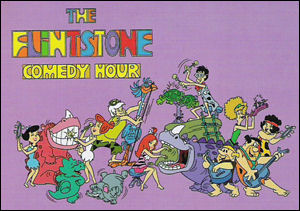
Today’s Retro Bin takes a look back at the CBS Saturday morning cartoon The Flintstone Comedy Hour (not to be confused with The Flintstones Comedy Show, which ran on NBC in 1980). Rather, this show ran a season after Pebbles & Bamm-Bamm, the 1st Flintstones spin off where the title duo were magically transformed from toddlers to teenagers. Voiced respectively by Sally Struthers and former child actor Jay North of TV’s Dennis the Menace (the black and white sitcom, that is) fame.

I don’t think that I need to explain the premise here; it’s the flippin’ Flintstones. The franchise has been around longer than Europe and if you were a kid in the 1970s, watching syndicated reruns of The Flintstones was just something that you did, like brushing your teeth or making your bed. We all know who these characters are and what this show is about, so instead, I’ll explain this particular venture: This series was made right after season 1 of Pebbles & Bamm-Bamm, so it picks up where that series left off. It was basically done in a variety show format (remember that this was 1972, and that genre of programming was still alive and kicking at the time). The 1st half hour consisted of new segments starring Fred and Barney, as well as jokes, skits and vignettes starring  Pebbles (this time around voiced by Mickey Stevens instead of Sally Struthers, who by this time was fully committed to her role as Gloria Bunker-Stivic on CBS’ All in the Family), Bamm-Bamm, Wiggy, Penny, Moonrock, The Bronto Bunch and Bad Luck Shleprock, while the second half hour consisted of 4 new episodes of P&BB combined with reruns from the previous season. Sadly, this was also the last Flintstones spin-off where Alan Reed voiced Fred. Mr. Reed passed away in 1977. Beginning with the syndicated Fred Flintstone and Friends (which debuted in October, 1977), Henry Corden took over the role of Fred and continued to voice the character until his own death in 2005.

Here’s the shows’ intro:

“We’ll have groovy time”? Really? That opening couldn’t be more 70s if it had been recorded in a boogie van that had love beads over the doorway! That said, when I saw these episodes again in reruns as a teenager in the 1980s, I totally wanted to “Yabba Dabba Doo” teenage Pebbles.

The 1st half hour was more or less a Laugh-In retread; with the characters performing in blackout gags, performing in short skits and telling groan worthy jokes. Such as one bit in which Zonk (of the Bronto Bunch) is trying make himself remember the name of the 49th State (Alaska) because he’s sure that his teacher Ms. Gravel is going to ask him to name it. In class, Ms. Gravel throws Zonk a curve by asking him to name the 50th State. Unprepared for this, Zonk stammers “Huh? Why…uh…” and Ms. Gravel answers “That’s correct! Hawaii (pronounced “Huh-why-uh” in order for the joke to work)!” A corny joke and perfectly harmless, except that the show is set in the Stone Age! Several centuries before the Colonies were formed. Logically, they should all be living on 1 big rock called Pangea or something similar. I really shouldn’t try to approach these kinds of things logically.

Undoubtedly the worst part of the show was the performances of the band The Bedrock Rockers (actually Pebbles, Bamm-Bamm and their friends) performing cheesy pop songs that were so unbelievably tame that they made the Archies look like Def Leppard. It was like a senior citizen’s version of a teenage rock band. Even for the early 70s, The Bedrock Rockers were about as hip and contemporary as Guy Lombardo. When the Osmonds tell you that your act is too squeaky clean, that’s not a good sign.

Anyway, the show returned in the fall of 1973 reduced to a half hour because the P&BB episodes were omitted, so it was then titled The Flinstone Comedy Show. Then 4 years later, many of the segments were recycled for the syndicated Fred Flintstone and Friends, including the Bedrock Rockers numbers for some reason (seriously, my ceiling fan makes better music) and many other Flintstones spin-off series would be produced by Hanna-Barbera over the next couple of decades (including the I-can’t-believe-this-actually-got-made concept Fred and Barney Meet the Thing, which we may be tackling here some time in the future).

Until recent years, there was never a gap longer than 2-4 years before a new Flintstones TV show or special was produced, and even now the characters are still appearing in Pebbles cereal commercials. Warner Brothers (which absorbed H-B in 1999) is working on a Flintstones DTV in which the characters appear with WWE wrestler John Cena. The joke here is that this isn’t a joke. It’s really going to happen. As long the characters don’t sing, we should be OK.

The Pac is Back

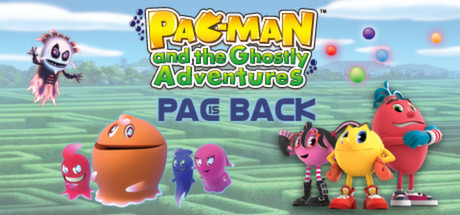
Back in June, we gave you a brief preview of Disney Close-Eyed Grin (XD)’s Pac-Man and the Ghostly Adventures, a new Japanese/Canadian/American computer-animated television series in production by 41 Entertainment based on Namco Bandai Games’ Pac-Man video game franchise. At the time, the series hadn’t premiered yet, but now that it’s made its’ debut (the series proper premiered on June 15th) and several episodes have aired, I can now give Ghostly Adventures a full review.

Pac-Man and the Ghostly Adventures

The premise isn’t anything you haven’t heard before: Pac-Man saves his native soil of Pac-World (as opposed to the Pac-Land of the 1982 Hanna-Barbera animated series) from ghosts. But the way it’s presented is new and different. This isn’t the Pac-Man of your older sibling who’s stuck in the 1980’s (“Skinny ties are coming back, man! Just wait and see! And man, Alien was a cool movie!”) Visually, Ghostly Adventures is a real treat: the show, which is presented in stereoscopic 3D, is one of the best looking CGI shows I’ve seen on TV. It takes us inside a beautiful, futuristic, high-tech Pac-World full of spherical and ovular buildings and spherical and ovular Pac-People, chock full of sci-fi tech such as hover-boards and other way-out gadgets, very bright, colorful and fun. The show’s cast is also quite colorful, but literally and figuratively:

The Heroes:

Pac-Man_Spiral_Cylindria_&_Zachary
Pac-Man himself (or just “Pac”, to give his more familiar name; the “Man” part is just a title bestowed upon him after saving Pac-World for the first time) is here portrayed as a happy-go-lucky, likable, energetic, well-meaning, sincere and good-natured (if a tad naive) teenager with a voracious appetite. On this show his yellow color scheme isn’t just for show, it actually ties into the premise: on this show Pac-Denizens come in a wide ranges of colors, as opposed to most of the previous media, where most of the Pac-People were yellow by default; the yellow Pac-Worlders are legendary heroes and the sworn protectors of Pac-World, as they’re the only Pac-People capable of eating ghosts. As such, Pac-World’s greatest threat has systematically hunted down and eliminated nearly all of the Yellows down to near-extinction, leaving Pac as seemingly the only yellow Pac-Worlder left alive (though other yellow Pac-Worlders are sometimes seen in the background, or maybe they’re supposed to be gold?). Not only is Pac the only one capable of devouring ghosts and spitting out their eyeballs, but he also receives unique powers and abilities by eating the magical Power Berries from the Tree of Life (this shows equivalent to the Power Pellets and the Power Forest), enabling such wacky-but-useful transformations and abilities as growing to giant size, bouncing around like a Super Ball, a fire form, an ice form, a titanium form with a magnetic tongue for attracting ghosties, a chameleon form with a long-stretching tongue (no, he doesn’t hock Geico insurance!) and more.
“Oh, sure. A short, round dude who gets crazy powers by eating stuff. Never seen that before! Real [bleep]ing original!”
*****************************
Cylindria (or Cylli for short) is one of Pac’s best friends and partners in crime on this show. She’s a lavender Pac-Girl with streaked purple-black hair, red-framed glasses, fingerless gloves, striped socks and black Goth boots. Cylli is basically the Hermoine Granger of the show, but thankfully she’s not overbearing with it. (Is it wrong to find a lavender ball somewhat adorkably hot? I’m asking for a friend.)
Sprial is Pac’s other best friend. With his large ovoid body, tuft of curly blue hair atop his head and bright red coloring, he resembles a living radish. While he may look weird, he’s a true and loyal friend to “the Pacster”, as he calls him. Spiral’s always got Pac’s back and is full of “cool” best bud phrases which he’ll spout at the drop of a hat.
President Stratos Spheros is the green colored President of Pac-World and the one who typically sends the Pac team out on its’ mission. He’s usually flanked by his semi-competent guards, who are all blue in color and wear sunglasses (The Men in Blue, perhaps?)
Sir Cumference (get it?) is Pac-World’s resident nutty inventor, also green, BTW, who builds and designs the team’s ghost-busting gadgets. He also fought in Pac-World War 1.
Spheria Suprema is a brave and sassy orange colored Pac Lady with a Southern accent. She’s another former PWW1 freedom fighter and is currently Pac-World’s reigning Pac-Pong champ. Spheria also happens to be Pac’s aunt, who is raising him now that his parents have been killed. (Awwwww.)
The Villains:
Commander/Lord Betrayus is the show’s main antagonist. He’s the absolute dictator of the Netherworld, similar to the character of Spooky from Pac-Man World 2. Once he was a Pac-Worlder, a dissident who attempted to take over the planet with an army of traitors, monsters and ghosts, launching Pac World War 1. (One thing I like about this series is that it actually gives its’ villain a back story which actually ties into his having once been one of them, as opposed to the HB show which just plonked a human would-be Gargamel onto the show with no explanation of who he was, where he came from, what his motivations were and how he came to be there). He was also the one responsible for the near-extinction of the Yellow Pac-Worlders. Upon his defeat, Betrayus and his followers were all stripped of the corporeal forms and banished to the Netherworld as ghosts, but after the portal sealing them all away was accidentally breached (by Pac, as it happens) Betrayus now hatches scheme after scheme to defeat Pac-Man and take over once and for all. He typically employs monsters, specters and gadgets, all of which fail week after week Rita Repulsa style. When Betrayus rages out (which is often) he emits fire. Betrayus has an ego the size of a mountain and is more than just a little nuts; as such his minions aren’t so much loyal to him as they’re too afraid of the wack-a-doodle to act any other way towards him. (Incidentally, Betrayus, both in corporeal and ghostly form, is white. As yet we haven’t seen any other white Pac-Worlders; perhaps Betrayus is a mutant, or maybe he just spent zero time in the sun.) Lord B. is also President Spheros’ brother.
Buttler is Betrayus’ hapless purple-gray colored personal servant. When he had a body he was a corporal in PWW1, who was secretly leaking secrets to Betrayus. After being discovered, which led to the defeat of Betrayus’ army, Betrayus blames him and now forces Buttler to serve him for all eternity. It’s fitting that he has a head shaped like a pair of buttocks, since he’s the frequent butt of jokes and target of abuse.
Dr. Buttocks is the Netherworld’s resident mad scientist, who creates the inventions Betrayus employs in his attempts for revenge. He resembles Buttler, only blue-gray in color instead of Buttler’s  purple-gray and with a mad scientist-required German accent. There’s a reason for their resemblance: they’re twin brothers, though they don’t get along: the Doc considers Buttler to be a lowly servant (which he is) while Buttler considers Buttocks to be a long-winded egomaniac (which he is). Buttocks’ ego is just as big as Betrayus’ and the 2 clash almost immediately.
Somewhere between the good guys and the bad guys are The Ghost Gang, the 4 ghosts from the games. Whereas before they were clear-cut villains, here they work as double-agents, leaking secrets, plans and advice to the good guys in order to fulfill their own personal agenda: they hope to get their bodies back. The Ghosts are even less loyal to Betrayus than the other spooks, though they’re not actually evil, just mischievous pranksters.
Blinky, the red ghost, acts as leader of the Ghost Gang (as opposed to the HB show, where he was a quaking coward in a farmer’s hat). Blinky speaks in a slanted, street-wise tough-guy brouque and helps the good guys when it suits his own purposes, though he’s quick to abandon the crusade to keep his ectoplasmic fat out of the fire.
Pinky, the pink ghost (duh!) is the only female member of the gang. (The HB cartoon was one of the few media where Pinky was portrayed as a male.) She has the same sass level as her brothers, but with a feminine charm. Pinky’s other defining trait is that she has a HUGE crush on Pac, and her desire for him often leads her to stick her (lack of) neck out further for the heroes than the others. As a side-effect, Pinky harbors an almost Pavlovian disdain for Cylindria.
Inky, the blue ghost, is a tad scatter-brained and a little spastic, but nowhere near the googly-eyed, tongue-wagging imbecile that he was in the HB show. Inky shares Blinky’s tough-guy mode of speech and desire to keep his rear covered over helping the good guys. In fact, Inky and Blinky are so much alike that they occasionally butt heads.
Clyde, the orange ghost, is a jumbo-sized gentle giant sized spook who, true to his game character, typically takes up the rear. Despite his slowness and somewhat vacant sounding voice, he is actually the most insightful member of the gang and is the most helpful. Clyde is also a pacifist, preferring to sit back and muse rather than scare people and pull pranks; Clyde’s gentleness and caring demeanor often annoys Blinky and Inky, but luckily Clyde is so huge that he can knock their heads together, literally.
Now, on to the gripes. Are there gripes? Really, the only gripe I have with the show is very minor: the recurring character of Skeebo, a blue-colored jock jerk in Pac’s class who insults and torments Pac for fun and who falls into the trope of Jerk Character Who Lives to Antagonize the Hero Even Though He Has No Reason to Actually Hate Him. He’s such an unneeded element to the show, especially since he has no clear cut motivations; we have no idea why Skeebo gets such a boner from hating on Pac, he just does. But thankfully, his machinations end up with him looking like a fool every time, so he hardly qualifies as a threat.
My overall rating: B. Pac-Man and the Ghostly Adventures won’t change your life, but it’s a fun way to kill a half-hour. The show managed to make me feel sympathy for a little yellow ball who’s lost his parents in a genocidal spree and now has the weight of his entire world hoisted onto his nonexistent shoulders. The show deserves credit for that alone.

Comments About Comments

We’ve been listening to our readers’ criticisms about our blog, and without a doubt, the 1 complaint that I’ve heard more than any other regarding the blog is that people are displeased with our decision to disable the ability for readers to post comments. Well, we’ve heard your complaints and since we want our readers to enjoy their stay here, we’ve decided to once again allow readers’ comments.

However, there’s a condition: instead of all comments showing up immediately like before, from now on all comments will need to be approved by us before they’ll be published. It’s just a precaution, you understand. It isn’t that we don’t like you guys or don’t trust you, we just don’t want this place to turn into a circus like it was when we first started it. The reason we disabled the comments in the first place was because we were tired of getting trolled; it had gotten to the point where we were receiving more troll and hate comments than legitimate ones. Having said that, here are Da Rules for readers’ comments:

1. All comments must be on topic. They have to be in some way connected to the subject of the article. Any and all off-topic posts will be rejected and deleted, no questions asked. So if all you have to say here is something along the lines of “I remember you; you annoyed me in 2005 on TV.com!” or “I know who Lord Dolmus is!”, or “I’m studying to be a lumberjack, can you give me tips on how to chop down trees?” or “Lose weight now, ask me how”, then don’t bother typing it, because it’s not going to get published. It’s very simple: if your comment doesn’t in any way pertain to the blog posts in question, then your comment will be rejected or marked as spam and will not be published.

2. All comments must be respectful. Both to us and to the other people wishing to comment. We don’t expect everyone to share our unique perspectives on things, and it’s perfectly OK with us if you disagree with something that one of us says, just as long as you do it in an intelligent, mature, responsible manner. However, if you’re just posting to insult us or to troll the site, your post(s) won’t ever see the light of day, so don’t bother typing them. If you want your comment to be approved, then it should be something other than “I hate this site!” or “You guys suck” or “You’re pathetic”. Be on-topic, polite and mature about what you post or your comments will be rejected, no questions asked. We promise to keep our comments polite, respectful and professional, so we expect you to do the same. Fair’s fair.

3. Only registered users may post comments. No anonymous comments will be published. It’s nothing personal; just business. This is just a way to ensure that we only receive legitimate comments here, and a way of preventing hate posts from Internet Tough Guys who hide behind the anonymity of a computer screen, spam posts from trolls and kids whose posts scream “I’M THIRTEEN AND UNSUPERVISED!!”

4. It goes without saying that no racist, sexist, political, religious or homophobic comments will be tolerated. Any such commentary will likewise be rejected and deleted, no questions asked.

Basically, we ask that you keep your comments clean, be respectful and stay on topic. We also reserve the right to end comment threads at our discretion.

We look forward to hearing your comments in the coming weeks and months.

Talkin’ Nerdy: Tiny Toons’ Head Scratching Adventures

By now, it’s no secret that I’m a Warner Brothers/Looney Tunes fan, and that like many WB/LT fans, that I’m also a fan of Steven Spielberg’s Tiny Toon Adventures. Although I personally like TTA’s successor Animaniacs a little more, TTA remains one of THE best cartoons to come from the 1990s.

Having said that, there are times when even a good show like Tiny Toons would deliver some moments that make you go “Huh?”. The Hub network’s recent acquiring TTA has brought to mind some such moments. Most notably, the episode “High Toon”, which contains no less than 3 head-scratching moments in a single scene.

HighToon-TitleCard

For those unfamiliar with the story, “High Toon” begins with Buster & Babs Bunny tunneling their way through the High Plains on the way to a theme park known as “Acmeland” (which we never see in the episode), but thanks to a mishap with switching signs courtesy of Beaky Buzzard, B&B are re-routed and end up in “No Man’s Land”, a lawless Western town whose citizens are are being terrorized by a gang of outlaws led by one Coyote Kid (who looks like Wile E. Coyote in a cowboy suit). After Babs and Buster (who initially think that they’re just watching a show) intervene and get their belongings stolen, they vow to bring the Coyote Kid and his gang of outlaws to justice.
The first “What the what?” moment occurs after one of the townspeople tells the rabbits that they would “need an army to beat the Coyote Kid”. Buster responds with “Then we’ll get an army!” He and Babs then leave and a minute later, they return with…….Hamton and Plucky (cue the ‘wah-wah’ musical sting). Now I realize that creatively speaking, this was merely done as a way to incorporate Plucky and Hamton into the story, which isn’t surprising, as the half hour TTA episodes typically focused on these 4 characters almost exclusively, but if this was just done to get Plucky and Hamton involved, then why not just have them there with Buster & Babs from the very start and not bothered with that whole “We’re going to get an army!” business at all? I’m surprised that none of the townsfolk said anything like “Hey, what gives? You said that you were going to get an army! That’s just 2 more people! That’s weak, man! We could’ve gotten 2 more people and saved you a trip! Four people isn’t army, it’s not even enough to be the starting lineup for a basketball team!” Trying to pass 2 more people as an army is no more logical than trying to pass off 2 more people as “The rest” on Gilligan’s Island. To quote comedienne Carol Liefer, “‘The rest’? Come on! It’s just 2 more people. They’re stranded on a desert island. At least let their families know that they’re still alive!”
The second head scratch moment occurs immediately afterwards, where we see Babs telling Plucky and Hamton the real reason why they were brought there; to help them bring in a vicious gang of coyote outlaws, only after they’ve arrived. So if Hamton and Plucky didn’t know that they’re brought there to bring down a gang of outlaws, then why were they both looking tough and menacing when they first arrive?
The third peculiarity is when learning about Buster & Babs’ intention to do battle with the Coyote Kid, Plucky typically wants no part of the skirmish and tries to leave, only for Buster to convince him stay with the promise that “There’s gold in them thar hills!” Plucky’s greed then takes over and now he wants in, but then the gold thing is never mentioned again anymore in the entire episode. This wasn’t the only time that Plucky’s greed was used as a motivation. In another episode, “Europe In Thirty Minutes”, Plucky at least twice plans to abandon the toons’ mission to stop the kidnapping attempt of Prince Charles and Princess Diana (the latter of whom was still alive when this episode was made), and each time this happened, either Buster or Babs would convince Plucky to stay with the prospect of him being knighted. This was a running gag throughout the episode; every time Plucky is about to bail, Buster and/or Babs dangle the porspect of knighthood under his beak and he’s back in.. And also in the episode “Hare Raising Night”, Buster tricks his buddies into accompanying him on his mission to stop the mad scientist Dr. Gene Splicer by telling them that they’re going to the Academy Awards. Plucky continues to believe this ruse long after Babs and Hamton have figured out that it’s false.  It’s not like Plucky to just forget about the prospect of getting rich.
Speaking of “Hare Raising Night”, it always struck me as being somewhat curious that Bugs would recruit 4 of his students to defeat a mad scientist instead of, you know, the police or a team of trained professionals. I know that it’s the Tiny Toons’ show, but still, it seemed odd that 4 toon students who aren’t special agents and have zero experience or special training in such matters would be selected for something that doesn’t directly affect them. Extra credit, perhaps?