
Today on Player Two Start, we pay tribute to Capcom’s much admired crossover fighter, X-Men VS Street Fighter.

Let’s take a little trip down Memory Lane. The year was 1996. One afternoon our younger brother Chaz (also known as CJP from the Otaku Gamer Spot–there, I plugged your site, bro, don’t say we never did anything for ya!) came home from school and informed us that a friend of his had told him that there was a new arcade game out in which the X-Men took on the characters from Street Fighter II. Naturally, we assumed he was pulling our collective legs, but after he loosened the snow tire chains from our ankles, a few days later we all headed out to the news/magazine stand at our local mall, and sho’ ’nuff, there was an issue of Electronic Gaming Monthly (this was back when there still were monthly game magazines, in the days B.I.–Before Internet) confirming that X-Men VS Street Fighter did indeed exist. One day, we’ve gotta pay our bro the 5 bucks we owe him. It’ll happen one day…..
And cue the eye-popping intro:
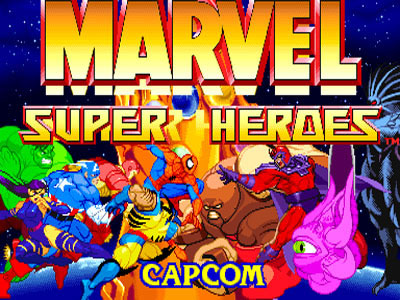
For the uninformed, X-Men VS Street Fighter was originally released as a coin-operated arcade game in 1996. It is Capcom’s third fighting game to feature Marvel Comics characters (the previous 2 being X-Men: Children of the Atom and Marvel Super Heroes, which Jason already covered in the very first Videots) and the first game to match them against their own, with characters from Marvel’s X-Men franchise being matched against the cast from the Street Fighter series. It was the first game to blend a tag team style of combat with the Street Fighter gameplay, as well as incorporating elements from Capcom’s previous Marvel-themed fighting games. The teams’ respective rosters went thusly:
Street Fighter: Akuma, Cammy, Charlie, Chun-Li, Dhalsim, Ken Masters, M. Bison, Ryu, Zangief
X-Men: Cyclops, Gambit, Juggernaut, Magneto, Rogue, Sabretooth, Storm, Wolverine
(I was a little disappointed that the my 2 favorite X-Men at the time, Jean Grey and Beast, were left out, but they at least appeared in various spots in the game: Jean was seen and mentioned briefly in Chun-Li’s ending, and Beast could be spotted in one of the backgrounds, sitting next to Blanka by a campfire. EDIT: That visual was actually from Marvel Super Heroes VS Street Fighter, the sequel.)
The plot (this game had a plot?) was that Ryu, during his travels, crosses paths with Cyclops and the X-Men, who show interest in Ryu’s power. When Apocalypse appears, stronger than ever before, Ryu’s friends and the X-Men band together to combat Apocalypse, some for the purpose of saving the world, and some for their own evil agendas.
This game came hot off the heels of the Street Fighter Zero/Alpha series, so the SF characters were all in their Alpha forms, as evidenced by the big ‘Z’ which slammed across the screen whenever a Street Fighter scored the winning blow (clean up your minds!), as opposed to the big ‘X’ which would clunk on to the screen if the final victor was an X-Men character. Of course we all know that the Street Fighters wouldn’t stand a chance in a real battle against superpowered mutants, so to even the odds, all the SF characters’ attacks were buffed out, meaning Ryu was tossing fireballs the size and length of bullet trains. This game marks the first appearance of the “Shadaloo” depiction of Cammy, who would reappear in the console versions of Street Fighter Alpha 2 Gold, as well as in Street Fighter Alpha 3. Speaking of costumes, like many people around my generation, my first ever real exposure to X-Men was the 90’s Fox Kids cartoon; I knew of the comics, but never really read them thoroughly, so at the time I didn’t realize that Sabretooth was wearing a costume; I thought all that fur and shaggy hide was actually his body!
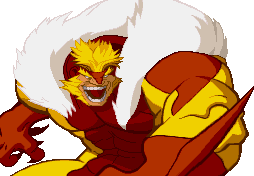
“Ya mean you thought I was walking’ around naked this whole time? Dude! I’m a bloodthirsty amoral sociopath, but even I got principles!”
X-Men vs. Street Fighter uses a system similar to the style developed in Marvel Super Heroes, and adds the tag team gameplay feature. Instead of the usual best-two-out-of-three round format, the game’s matches consist of two-on-two battles between tag teams. The player controls one character at a time, while the other awaits off-screen. The starting character can tag the waiting one in at any time by hitting the Hard Punch and Hard Kick buttons, which activates the “Variable Attack”; the tag partner will jump in with an attack and taunt briefly. During their taunt, they are vulnerable to counterattack. The dormant character will able to recover a portion of their vitality, while the current character is fighting. If one character loses all of their vitality, then the tag partner will automatically come to play. A match is over when both members of a team are defeated or if the timer on the match clock reaches zero.
There are other ways to bring the character’s partner in; the “Variable Counter”, which replaces the Infinity Counter of Marvel Super Heroes, breaks the player’s guard to bring the teammate in with a counterattack at the cost of a level of super meter. Also, the “Variable Combination” is a two-character Hyper Combo (the super moves featured in the game) which costs two levels, and will switch the player’s current character as long as neither character gets hit during their Hyper Combos.
In 1998, the game got a home console port for the PS1, which was just called the PlayStation at the time since there weren’t any others, but the PS version received mixed to negative reaction from fans, due to several frames of animation being cut, making the characters’ movements a tad choppy, slowdowns during the special moves that made the game essentially unplayable and worst of all, NO TAG-TEAMING! For the reason why, I refer you to our resident Tech Guy, Mr. Edgar Eaglebeak:


“Well, you see, the original PlayStation, or PS1 for you laymen, was a disc-based console. As such, the console’s RAM, or Random Access Memory, was significantly lower than that of the arcade cabinet. Every frame of animation of each character: their punches, kicks, supers, win/loss animations, what have you, needed to be stored onto the consoles discs and hard drive, and consequently loaded onto the game’s engine. However, the PS1 only had enough memory to store all of the animations for 2 characters to be on the screen at the same time, but as a 2-on-2 tag-team based combat title, X-Men VS Street Fighter required for there to be full animations for 4 characters at a time. So Joe Gamer would have had to choose between waiting long loading times each and every time they switched characters or simply contending with no tag-teaming in the main battle mode. Sony chose the second option. Instead, the PS version used a traditional best-two-of-three round setup in a similar manner to Rival Schools: United By Fate, with the player’s chosen partner only emerging on screen briefly as a ‘striker’, if you will, for Super attacks. However, it was possible to have a tag-team match through two-player “Crossover Mode”, provided that each player used a clone of their opponent as their partner. For example, if the player was controlling Ryu and his opponent was Wolverine, then the player’s partner would have to be Wolverine and the opponent’s partner would have to be Ryu. Now if you’ll excuse me, I must finish downloading the unreleased script for Man of Steel 2 from the internet and then resume my training for World of Warcraft. I’m a Level 42 Paladin!”
The was also a Sega Saturn version of the game, which was able to incorporate tag-teaming, since it was a cartridge based console, but I didn’t own a Sega Saturn nor did I know anybody who did, so I never got to play that version.
Apocalypse was the final boss of the game and lacked a tag partner. (No surprises there; the dude was freakin’ HUGE! Why would he need a partner?) After defeating him, the character that defeated Apocalypse was forced to fight his or her teammate (the game would not accept new challengers at that time). Once the CPU-controlled teammate was defeated, the game would show the player-controlled character’s ending. Or you could just view them here:
Ah, the 90’s cheese. I could listen to that hammy Kraftwerk synthesizer all night!
(But Ryu really thought he could just walk back to Earth from the moon? OK.)
So, hats off to X-Men VS Street Fighter. This game started the aeon flux of Capcom crossover titles (affectionately referred to as the ‘Capcom VS’ series) such as Marvel Super Heroes VS Street Fighter, Marvel VS Capcoms 1-3, Capcom VS SNKs 1 and 2, SNK VS Capcoms 1 and 2, Tatsunoku VS Capcom and others, but X-Men VS Street Fighter will always hold a special place in my heart since it was the first, and since I was huge mutant freak at the time. I’m still a mutant freak, but not as big an X-Men fan as I was back in the day. For making many peoples’ fanboy and fangirl fatasies come true and allowing me to assemble my awesome killer tag-team of Rogue and Storm to lay waste to my opponents, we at Twinsanity salute you.

SAAA-LUTE!!!

 Twin Images
You must be logged in to post a comment.