
On this installment of Player Two Start, I’ll be paying tribute to a much liked but mostly forgotten title; Konami’s Sunset Riders.

Sunset Riders is a side-scrolling run-and-gun style shoot-’em-up released by Konami as a coin-operated video game in 1991. The game is set during the American Old West, where the player takes control of a bounty hunter who is seeking the rewards offered for various criminals. The coin-op version was released in two variants: a 2-player version and a 4-player version. Home versions of Sunset Riders were released for the Sega Mega Drive (Genesis) in 1992 and for the Super Nintendo Entertainment System in 1993.
My first exposure to this game was when I saw it my local bowling alley. I watched 2 people go through the game. One reason why this game interested me was that there weren’t many games video games focusing on American Wild West Cowboys.
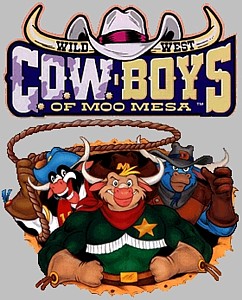
“Yippee-Yi-Yo-Cow-Yea! And other bad cattle puns!”
Yeah, I know these guys had a video game too, but Sunset Riders came first and I’ve never actually played the Moo Mesa game.
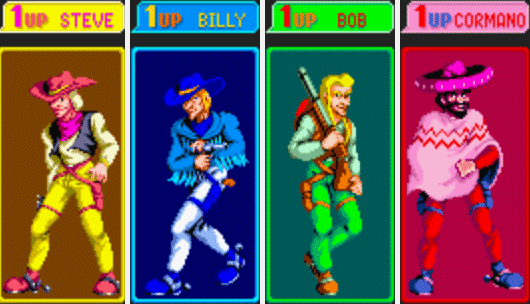
The game, which is set in a fanciful version of the American Old West, revolves around four bounty hunters named Steve, Billy, Bob, and Cormano who are out to claim rewards given for eliminating the most wanted outlaws in the West. At the beginning of each stage the player is shown a wanted poster, showing the criminal, the reward for stopping them, and the line “Wanted dead or alive”.
The criminals had names like Simon Greedwell, Hawkeye Hank Hatfield, El Greco and Paco Loco. One thing that I especially liked about this game was the soundtrack. Enjoy these Western jams:
All right! Pass me a beer (root, that is)!
Two years after the arcade game came out, I bought the home version for the Super NES. We rented the Sega Genesis version once…only once. Neither the SNES nor the Genesis version of Sunset Riders were 100% translations of the arcade game, but the SNES version was the better of the 2. Out of the four main characters from the arcade game, only Billy and Cormano are featured. The two characters in the Genesis version were given surnames that they originally didn’t have in the arcade version (Billy Cool and Cormano Wild). The controls are identical to the arcade version aside from the addition of two shooting buttons instead of just one: one button allows the player to walk and shoot at the same time, while the other shoot button keeps the character still when pressed down, allowing the player to change their aim only. Only four of the eight bosses from the arcade version are featured, and each of the four chapters are divided into two stages. Each boss dialogue is worded in a text bubble instead of voiced. The power-up icons have also been replaced as well. Unlike the other versions, the player can cause a dynamite stick to explode by shooting it. To access the bonus stages, the player must collect a Star-shaped item located in either stage of each chapter. The bonus stages also differ from the ones in the arcade version: the player chases after a moving wagon on a horseback, while the woman in the wagon tosses bonus coins and extra lives at the player’s path. The best thing about the Genesis version was that it had a code where you could give yourself 99 continues.
The SNES version was better (here, all 4 of the main characters were included and playable), but it wasn’t a perfect translation either. a few changes were made for the home version:
- The barfly that kisses the player character in Stage 1 as well as the saloon dancers from Stage 4 are dressed more conservatively compared to the arcade version.
- Hunter dogs, which were present in first segment of the final chapter in the Genesis version, were removed.
- The characters’ dialogue is printed as on screen captions as the characters speak their lines.
- the Native American enemy characters from Stage 6 were removed and replaced with regular outlaws, leaving only Chief Scalpem (who is renamed Chief Wigwam and re-voiced in the SNES game) as the stage boss.
- The dynamite tossing female bandits were replaced with male bandits in the SNES port as well.
- In Stage 1 in the arcade version, when the bounty hunters come out of the saloon, they’re shown taking a swig, but in the SNES version, they just pose. Come on, guys! It’s a saloon! We all know what went on in saloons. Guys weren’t playing marbles in there!
- While most voice clips are carried over from the arcade, some voice lines are either re-worded or replaced with other less offensive lines for censorship purposes. For example, one of the later end level bosses, El Greco, in the arcade version says to the protagonists “Die, Gringo!” just before the gun fight starts, and then “Adios, amigo!” after he’s defeated. However, in the SNES version, El Greco just says “Adios, amigo!” twice. Another example, in the Smith Brothers saloon in the arcade, one Smith Brother says “We’re gonna blow you away!” and then the other one says “Yeah! Yeah!”, but in the SNES version, only the first brother speaks. Also, after the Brothers are defeated, the first one of them to die says “Holy smoke!”, while the second one before dying says “That was a bang!”, but in the SNES version, the “Holy smoke!” line is taken out. Goodness knows that we can’t show a character using the word “Holy” in a game about bounty hunters and outlaws shooting each other to death.

The PC Police strikes again!
One of the great mysteries of the universe is: why did this game never get a sequel, update or a follow-up game? Aero the Acrobat got a sequel. Joe & Mac got a sequel. Chuck Rock got a sequel. Gex got a sequel. Bug got a sequel. Toe Jam & Earl got a sequel. Bubsy got 3 sequels! If Bubsy and Toe Jam and Earl can get new titles, then why on Earth has no one ever attempted to revive Sunset Riders? Just about everything comes back nostalgically, so perhaps one day someone will decide that it’s time to bring Sunset Riders into the 21st century. Just about everything else from the 1990s is getting revived.
Well, maybe not these guys.
…but until then, let’s offer a salute to Sunset Riders. Maybe I’ll play this game again…if I can ever recover my old NES from whatever forgotten limbo it’s currently floating around in.
.jpg)

 Twin Images
You must be logged in to post a comment.