It’s time for another segment of The Couch. In this installment, we’ll be looking back at the Hanna-Barbera syndicated series Wake, Rattle and Roll.
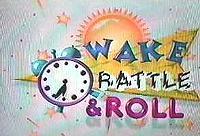
Some people may feel that discussing this series here is a cheat, since it’s not technically a cartoon, but Wake, Rattle and Roll did have regular animated segments in every episode but with live action host segments, so WR&R is a live action/animation hybrid, not unlike The Super Mario Brothers Super Show!, so it still counts. In any case, Wake Rattle and Roll was a series produced by Hanna-Barbera Studios which ran on weekday mornings for only a single season (1990) in first run syndication.
Wake, Rattle and Roll focused on a boy named Sam Baxter (played by then child actor R.J. Williams, who previously voiced the title character on NBC’s Kissyfur and who also voiced the character of Kid Cloudkicker on Disney’s Tale Spin. This kid has a knack for voicing cartoon bears.) and his robot DECKS (which was an acronym for Digital Electronic Cassette-Headed Kinetic System). DECKS was built from old audio-video equipment and was voiced by none other than Rob Paulsen. Mr.Paulsen also voiced Dickie Dastardly on H-B’s Yo, Yogi! that same year, but we like Rob, so we’ll forgive him. Sam and DECKS would have random misadventures in their basement, which was full of impossibly sci-fi high inspired tech, such as a People Processor -a teleporter used to send or retrieve people to and from anywhere in the world. Sometimes, it could even send people through time, a supercomputer called Mondo View that was used for several reasons on the show, for example, Sam is able to talk to Grandpa Quirk anywhere in the world, and a Debbie Detector, which was a video monitor used by Sam and DECKS to communicate with Sam’s older sister Debbie (played by Terri Ivens) which lessens the amount of time Debbie spends in the basement. It often makes an alarm sound when she approaches. Interestingly, Terri Irvens previously appeared in the short lived FOX teen sitcom Boys Will Be Boys (1987-1988) starring the pre-Friends Matthew Perry as “Chazz”. Other supporting characters included Sam’s wacky-but-brilliant inventor grandfather Lester T. Quirk (played by Avery Schreiber), who constantly supplied Sam & DECKS with sci-fi technology to add to their basement, Sam’s platonic girl friend K.C. – but not the Sunshine Band – (played by Ebonie Smith, who’s perhaps best known for playing Danny Glover’s youngest daughter in the Lethal Weapon movies) and Sam and Debbie’s mother, Mrs. Baxter, voiced by Adrienne Barbeau. Ms. Barbeau never appeared on screen. We only heard her voice, like Orson on Mork and Mindy. Not even a cheesy leg shot. Sorry, guys.
*****************************************
Here’s the shows’ opening:
In a typical episode, Sam and DECKS would do some shtick, and then DECKS would activate the television screen on his torso and display an animated short. There were 2 shorts which were created specifically for the series: Monster Tails and The Fender Bender 500. Monster Tails focused on the pets of the famous movie monsters who all lived together in a castle in Transylvania, which was maintained by Igor’s son, Iggy Jr. (voiced by Charles Adler) while their famous owners were making movies in Hollywood. The main cast consisted of:
Frankenmutt (voiced by Frank Welker) – The pet dog of Frankenstien’s monster, who unlike his master, possessed the brain of a genius.
Elsa (voiced by Pat Musick) – The pet dog of the Bride of Frankenstien, who has the brain of a parrot.
Catula (voiced like Iggy Jr. by Charlie Adler) – The pet cat of Count Dracula, who like his master is pretty arrogant, but has a mastery of magic and transformations.
Mumphrey (Frank Welker again, doing his best Woody Allen impression) – The pet dog of The Mummy.
Dr. Veenie (voiced by Jonathan Winters) – The pet dog of Dr. Jekyll. Normally a brilliant scientist but who like his famous master, had a mindlessly monstrous destructive alter ego named Mr. Snyde, which manifested every time the good doctor sneezed.
Angel (Pat Musick again) – The pet goldfish of The Creature from the Black Lagoon. She floated around the castle without the need of water because she was a ghost, a fate which befell her after being eaten by a shark some time before the first episode.
The other regular animated segment was The Fender Bender 500, basically an update of H-B’s Wacky Races, only this time with established H-B characters as the competitors. The racers and cars consisted of:
00 – Dick Dastardly and Muttley in the Dirty Truckster (Design wise, it was the Mean Machine with monster truck wheels)
1 – Yogi and Boo-Boo in the Jellystone Jammer (Which looked like a picnic basket on wheels)
2 – Huckleberry Hound and Snagglepuss in the Half Dog, Half Cat Half Track (Try saying that 3 times fast!)
3- Wally Gator and Magilla Gorilla in the Swamp Stomper (A swamp buggy on wheels. Gorillas don’t generally live in swamps, but let’s not nitpick here.)
4 – Top Cat and Choo-Choo in the Alley Cat (Which looked like a trash can on wheels)
5 – Quick Draw McGraw and Baba Looey in the Texas Twister (Which resembled a motorized covered wagon. Not to be confused with the song by Little Feat or the obscure Marvel Comics character)
6 – Pixie & Dixie in the Cheddar Shredder (Which looked like a wedge of cheddar cheese on wheels)
7 – Auggie Doggie and Doggy Daddy in the Lucky Trucky (which I swear sounds like the title of a preschool show to me)
13 – Winsome Witch with her cat Lucky in the Sonic Broom (It was a cauldron on wheels with a pair of broomsticks for the exhaust pipes)
Those familiar with the Wacky Races already know what to expect from this show. Fender Bender 500 didn’t win any points for originality, but it did have a couple of strong points: For one, the announcer was disc jockey Shadoe Stevens. For another, it brought the character of Winsome Witch back to television.
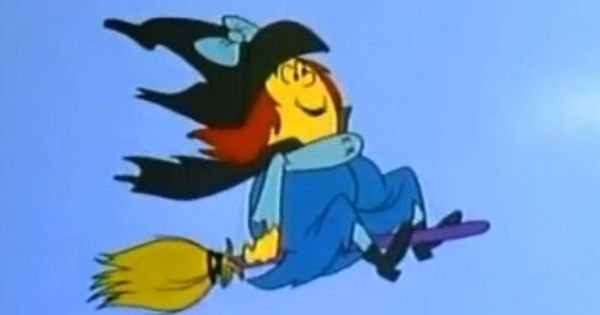
“Seriously? It took Hanna-Barbera this long to remember that I exist? I wasn’t even asked to be in Laff-A-Lympics, for crying out loud! Do you have to be a talking animal wearing a tie to get a part on one these shows?”
Trivia Time: The series’ title was a play on the title of the song “Shake Rattle and Roll”, written in 1954 by Jesse Stone and most famously performed by Bill Haley and His Comets.
After WR&R ended its run in syndication after 1 season, the reruns were acquired by the Disney Channel from October 1991 to 1994. Because TDC aired the series in the afternoons, the title was changed to Jump, Rattle and Roll. Also, because Disney Channel was commercial free at the time, an additional cartoon (referred to as a “Secret Cartoon”) was added after the live action segments as a time filler. This “secret cartoon” would either be reruns of the “Dino and Cavemouse” (basically a prehistoric Tom & Jerry retread) segments from The Flintstones Comedy Show or reruns of “Undercover Elephant” from H-B’s CB Bears show. I didn’t have the Disney Channel at the time (TDC wouldn’t become part of any basic cable package until a few years later), so I only caught the Disney Channel airings sporadically. Every time that I tuned in to Jump, Rattle and Roll, the “secret cartoon” would always be “Dino and Cavemouse” Lucky me.
Wake, Rattle and Roll wasn’t a great show by any means. The jokes were corny. The plots were predictable, but of course, this was a kids’ show, so I wasn’t expecting the writing to be on the level of Yes, Minister or anything. However, I can’t bring myself to disliking the show. There was something about the shows’ premise that I found to be somewhat appealing. The live action segments had a certain campy charm to them, similar to the live action host wraparounds on The Super Mario Brothers Super Show! (which have aged significantly better than that series’ cartoon segments, in my honest opinion). It could by my inner geek speaking here, but I can’t dislike a series that has wacky sci-fi inspired inventions as part of it’s premise. I actually had an idea for an animated series which was loosely inspired by the live action segments of WR&R; about a pair of fun-loving young kid siblings who would spend the day playing around with goofy science in their high-tech suburban home, driving their parents and neighbors crazy. Kind of like Johnny Test, only good.
So here’s to you, Wake, Rattle & Roll. You weren’t on the air for very long, but your presence at least made an impact on this geek.
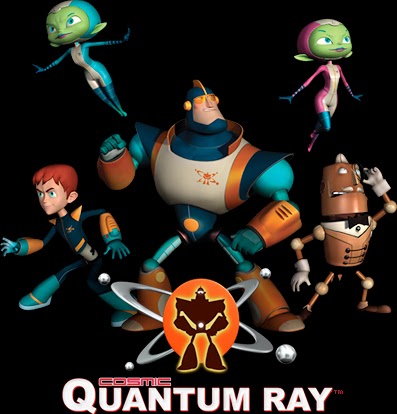
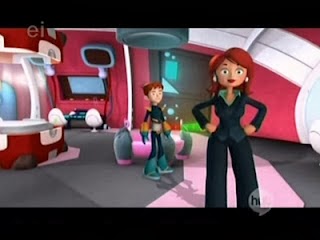
It’s time for another installment of The Couch. Today we look at one of the first shows to air on The Hub, the science themed animated sci-fi comedy Cosmic Quantum Ray.
Cosmic Quantum Ray premiered on October 10, 2010 on Hub Network, and ended on December 9, 2010 with 26 episodes. It was produced by Moonscoop, Mike Young Productions, Method Films, and Telegael Torenta. The series had reruns on The Hub until November 4, 2013.
Although produced by Germany’s KI.KA and France’s M6, the show was written in English, the writing supervised by Head Writers/Co-producers and Emmy winners Pamela Hickey and Dennys McCoy. In 2009, the series beat out Nickelodeon, Disney and Cartoon Network to win the Pulcinella Award for BEST TV SERIES. The series was created by cosmologist Dr. Mani Bhaumik. Hickey and McCoy based all their stories on principles and theories from quantum physics, with Dr. Bhaumik literally providing the math.
Cosmic Quantum Ray was billed as a bizarre comedy/sci-fi adventure (emphasis on “bizarre comedy”) that, at the end of each episode, explained the quantum physics associated with a story and/or physical gags found within the series.
CQR centered on Everyteen Robbie Shipton, an average kid with an average life and a fairly hot seemingly single real estate agent mom, who through means which were never explained, possessed a shoe box leading to the 9th Dimension (the point in space-time of uncertainty, probability, possibility and chaos wherein we can compare all the possible universes’ histories starting with all the different possible laws of physics and initial conditions, according to some string theorists). Sound weird? Well, Dexter has a super-advanced high-tech science laboratory with TARDIS-like diemsnions within the bowels of his ordinary suburban home, and Lydia Deetz is best friends with a gross con-artist ghost from the Neitherworld. So why not a shoe box leading to the 9th Dimension? Said shoe box is also the home of intergalactic superhero Quantum Ray, leader of a band of sci-fi weirdo do-gooders known as Team Quantum, dedicated to upholding Natural Law throughout the cosmos or something similar, with Robbie in tow as the Eager Young Space Cadet, fighting such space and science themed baddies as a body-snatching spore, a haughty space worm who would make portable wormholes (get it?), a purple skinned mad scientist and his nagging mother who was trapped in the body of a hamster, an indestructible surfer dude who rode a gamma ray powered surfboard and a pair of militant military squirrels. Team Quantum consisted of:
Quantum Ray himself is the leader of Team Quantum, but in truth he’s captain of the team in the same manner that Arthur “Big Guy” Carlson was in charge of the radio station on WKRP in Cincinnati. Ray is a big muscular man-child of a superhero, sort of a cross between The Tick and SpongeBob Squarepants. (The latter comparison in particularly ironic, since Ray was also voiced by Tom Kenny). Ray was a cosmic being from the 9th Dimension. He is brave, determined and occasionally clever, though he sometimes comes off as a bit “flaky” or “weird” – but he’s just thinking “differently” than we 3-dimensional creatures, as his mind occupies 6 additional dimensions. He possessed a uniquely bizarre but still kind of kick-ass super power set: As a being from the 9th dimension, not all of Ray’s body can be seen – his elbows, knees and midriff are all in “higher” dimensions (we can’t see them, but Ray can). Ray’s body parts can also be detached at times when called for; he is held together by a cosmic essence of unknown origin that only Ray or other higher dimensional beings can see. As a 9th dimensional man, Ray can also see celestial objects and scientific phenomena that 3-dimensional beings cannot, like P-branes and tesseracts. Ray was also super-strong, able to fly and he could also control and change his atoms into any inorganic material he wants: he can turn to titanium, diamond, rubber, brick, iron, gold, and silver – anything he needs to get the “hero job” done. As a higher dimensional being, Quantum Ray sometimes forgets that not everyone occupies several planes of time, space and reality simultaneously, not everybody’s appendages are modular, and that most people have to obey the basic laws of physics. He referred to Robbie as his “young sidekick” and his tagline was “Halt! In the name of Natural Law!”
Atee and Geecee are a pair of super-cute pint-sized, green-skinned, pointy-eared, hovering teenage twin alien honeys from the planet Tooferwun –a planet where everyone is a twin (and you used to wonder where we came from) therefore they count as a single member of Team Quantum. Identical in appearance, the only way to tell them apart was by their costumes and demeanor: Atee, who wore a pink costume, was sweet-voiced and dainty, whereas Geecee, who wore a baby blue costume, was gravelly voiced and scrappy. The twins were the lead-footed pilots of the ship, knowing only 2 speeds: fast and faster. They were also lazy, declining to perform any other duties with their line, “We’re pilots. We don’t do (whatever additional task they were asked to perform).” In addition to the ability to hover and fly (the twins are seen floating more often than walking), the twins have a superpower that only works when they combine their bodies together to form “Double Helix” – a large band of super-strong, super-elastic DNA that can catch, launch or catapult villains, dangerous objects (like out of control meteorites) – or even their fellow teammates. The twins generate their “Double Helix” ability through the soles of their feet as a sort of contrail, and they control the helixes by flying around. The twins’ “Double Helix” power is activated when they touch each other and speak the phrase, “Two for one, we’re double fun! We’re Double Helix!” (It was unclear if this phrase was necessary or just a habit of theirs. Physical contact, however, is required. If the two are out of reach of each other, they are unable to activate their power.) Their one weakness is separation. They are “connected” on a quantum level…should they be separated they would be powerless. And if they are separated for a very long period of time… they could cease to exist as we know them (but being quantum, we’re not quite sure what they would become). Being teenagers, Atee and Geecee seemed to have a mild crush on Robbie, they were definitely ga-ga over his hair, as they tried to touch it, snip it or sample it in just about every episode. Their names didn’t just sound science fiction-y, they were also a reference to the components of a DNA molecule: Adenine Thymine (Atee) and Guanine Cytosine (Geecee).
Bucketworth was a bronze plated sentient robot and the brains of the team. Luminously intelligent, educated and refined, he was designed with a mustache, bow tie and a monocle from which he could project holographic images. Bucketworth acted as the sarcastic Mr. Spock to Ray’s clueless captain Kirk. While he possessed no super powers (beyond being a self-aware robot) he possessed a genius level IQ, and could invent handy devices and impeccable strategies to win the day. Bucketworth also delivered the science lessons at the conclusion of each episode. Ever the refined gentleman, he always referred to Robbie as ‘Robert’ and Ray as ‘Raymond’.
Robbie Shipton himself acted as Ray’s protege and the show’s audience avatar. He had no super powers, but provided common sense and oasis of calm within the group. While in ‘space hero’ mode, Robbie’s outfit switched to a snazzy navy blue and gold space suit with pointed shoulder blades and his glasses would mysteriously disappear.
Robbie had another distinction: he was the only member of Team Quantum who had a secret identity. Robbie led the obligatory double life on Earth, and all of the episodes would somehow involve his high school and the usual string of colorful high-school characters: Lucas, the uptight overachieving nerd, Allison, the cute but annoyingly preachy vegan/animal rights activist, Scott Stotz, the jock jerk, Scott’s hulking goonish cronies Dustin and Justin, who never spoke but whose ‘dialogue’ usually consisted of them giggling like Beavis and Butthead, and Chip Monohan, the school mascot who never took off his squirrel costume (the show’s producers seemed to have a “thing” for squirrels, since a pair of squirrels were also among the show’s recurring villains). Chip also holds the distinction of being the only cast member outside of Team Quantum to have appeared in every episode of the series. So Robbie and crew had to spend many an episode making up hee-larious excuses for all of the bizarre events that went on around them, and the other kids just thought Robbie was a weirdo geek who made up loony space stories.
Cosmic Quantum Ray wasn’t a bad show by any means; it was pretty fun, and I did learn some cool science stuff from it (it was from CQR that I learned what a quantum computer is, what qubits are and it’s what got me interested in string theory), but in short order, it did become a bit repetitive, what with the heroes facing the same revolving door of villains every time, and how each episode had to somehow involve Robbie’s school, invariably leading to another character discovering the truth about Robbie’s outer space escapades and exclaiming, “My gosh! Those stories you tell! They’re TRUE!!” only to get their memories erased (usually by Bucketworth) again and again and again. This happened so frequently that one episode even turned it into an in-universe joke. I would’ve liked to have seen a few episodes in which Robbie’s school chums were altogether missing, which took place completely in space and where they dealt with no villains at all; surely there were enough scienctific and astronomical themed disasters and anomalies which would’ve made for interesting stories without the constant need of a costumed antagonist and adherence to the standard “wash, rinse, repeat” formula. And I REALLY would’ve liked to have seen another character learn the truth about Team Quantum and NOT get their minds wiped at the end. I’ve never liked that “I am/have/can do something really cool, but have to keep it a secret from everybody” trope, especially when no reason is given for why everything must be a big secret. I can understand keeping the existence of aliens a secret from the feds; you don’t want your homies getting locked up and dissected (indeed, the gang did go to Area 51 in one episode and nearly met with such a fate), but I think you can at least let family and close friends in on it. I especially didn’t see why Robbie’s mom Debbie couldn’t have known about it; she actually found out about Team Quantum in 2 episodes, “What’s Up with Gravity?” and “Unreal Estate”, and each time she found out, she seemed okay with it, in fact at the end of the former episode she confides in her son that she really liked Team Quantum, so she obviously wasn’t going to blow the whistle on them, so why did she have to get her mind erased? You’d think having a parent in your corner would work to your advantage; she could cover for you when people start to ask why you keeping missing class or whatever. Not to mention Debbie got her Crowning Moment of Awesome in her first appearance by stating that she’d totally mess up any villain who screwed with her kid, and later does it! any lady who can pull a villain’s lower lip up over her head–literally!–is A-OK in my book.
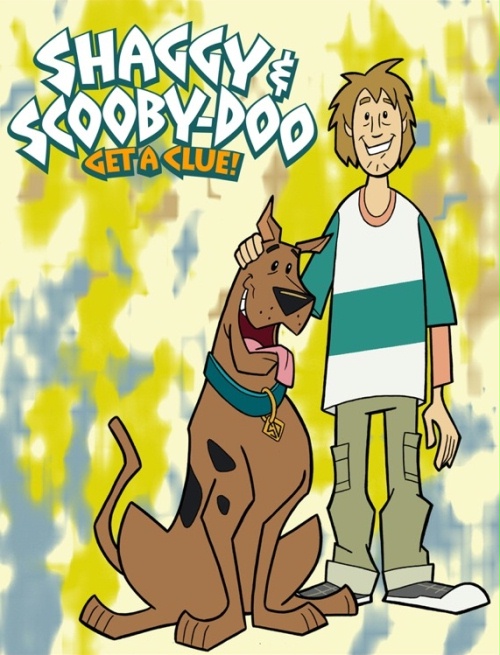
Today the Couch looks at the quickly gone and forgotten 10th incarnation of Hanna-Barbera’s Scooby-Doo franchise, Warner Brothers’ Shaggy and Scooby-Doo Get a Clue!.
Shaggy and Scooby-Doo Get a Clue! debuted on September 23, 2006, and ran for two seasons during the Kids WB Saturday morning block of The CW Television Network. The show’s second season premiered on Teletoon in Canada on September 6, 2010.
This series boasted a number of notable features: Despite being produced by Warner Bros. Animation, this was the last cartoon series produced by Hanna-Barbera co-founder Joseph Barbera. This show also came along right on the heels of the 2002 live-action Scooby-Doo movie, so the characters were redesigned to resemble their movie counterparts; Scooby was drawn with dot eyes, for example. Get a Clue! was the third show in the Scooby-Doo franchise, after A Pup Named Scooby-Doo and What’s New, Scooby-Doo?, that was not animated or drawn in the usual Hanna-Barbera style. This was also the first series in which Casey Kasem did not voice Shaggy, but was instead done by Scott Menville (although Scott Innes or Billy West have portrayed the character in many of the Scooby-Doo animated movies made for television or home video). However, in this series, Kasem did voice Shaggy’s rich and on-the-run Uncle Albert. Another noticeable difference was that Shaggy wore a white short-sleeved shirt with a green stripe across the middle and green sleeves instead of his trademark green t-shirt (Shag didn’t even sport his red shirt from the 80’s here). Frank Welker still did Scooby’s voice, replacing the late great Don Messick, who died of a stroke in 1996. In addition, Shaggy and Scooby are considerably not as cowardly this time around.
Get a Clue! was one of the rare Scooby shows which deviated from the usual formula of the Mystery, Inc. gang solving mysteries involving fake ghosts and monsters. Unlike in, say, The 13 Ghosts of Scooby-Doo, in which the selling point was that the monsters were real, here we got no ghouls, spooks or ghosties at all, real or otherwise. The premise of the show revolves around the fact that Shaggy Rogers’ incredibly rich Uncle Albert Shaggleford disappears and names Shaggy as his sole heir for an inheritance. With the help of the inheritance, Shaggy has upgraded the Mystery Machine, so it now has the ability to transform itself into a number of other different vehicles, like the “Hot Dog Making Machine”.
Dr. Albert Shaggleford had made some enemies before disappearing, though. Among the most dangerous is the archetypal evil genius and technology pirate out to take over the world and/or become immortal–truth be told, his motivations were about as clear as Gargamel’s—Dr. Phineas Phibes (who gets his name from the Vincent Price villain The Abominable Dr. Phibes). Dr. Phibes recruits various sidekicks and minions to help him with his plans, among them Dr. Trebla. (Dun-dun-dunnn!)
It appears that the supposedly late Dr. Shaggleford was, beyond being rich, an inventor in his own right, and his clueless young heir is now in possession of some very interesting nano technology. The top secret nanotech formula has been mixed in with Scooby Snacks, which, when eaten, cause a variety of day-saving side effects.
The duo are also aided by Robi, A loyal robotic servant with a tendency to bust through walls and other highly destructive things without second thoughts. Robi would also have various uses for Shaggy and Scooby, though he is a rather lousy cook, various impressions, and giving out safety tips Insector Gadget style. He also projects holograms of Uncle Albert when he wants to talk with Shaggy. One clever bit was that Robi also usually called Scooby “Rooby Roo” due to misunderstanding Scooby’s unique vocalizations.
Shaggy and Scooby-Doo have a mission: armed with an updated Mystery Machine, a loyal robot servant, their new riches and the new and improved Scooby Snacks, they must stop the evil plans of Phineas Phibes and save the world. In episode 2, Shaggy upgrades the Mystery Machine from its original form, to a high-tech transforming vehicle. However, it usually transforms into machines inappropriate for the tasks at hand. In their spare time, Shaggy and Scooby are fans of the show Chefs of Steel, the famous mystery solver Chad Chatington, and the giant monster-fighting robot named Badgerly, the Adverb.
What of the rest of the gang? Fred Jones, Daphne Blake and Velma Dinkley only made occasional appearances; only appearing in 2 episodes of season 1. Fred and Daphne made a non-speaking cameo in a single season 2 episode, getting barred from entrance to a party. However, their silhouettes run across the screen in the opening credits in amongst the silhouettes of all the show’s regular cast.
“Hey kids, you’re probably wondering why we didn’t get a bigger role on this show. Well frankly, so are we! Why do I keep getting passed over? I’m hot!”
“No parts for us in any of the Superstars 10 movies and now this? Seriously, what’s the deal? You gotta be perpetually hungry to get a decent role on one of these shows??”
“Look on the bright side. At least we didn’t have to appear in those lame-oh Richie Rich/Scooby-Doo Show episodes where it was just Shaggy, Scooby and Scrappy driving around the countryside being chased by somebody! Geez Louise, what were they thinking??”
Trivia Time: Coincidentally this is not the first time that Frank Welker has done the voice of Scott Menville’s pet as the two of them did the voice of Ma-Ti (Menville) and his pet monkey Suchi (Welker) in the 1990-96 cartoon Captain Planet and the Planeteers.
Further coincidence is Scott Menville’s voicing Shaggy, a character previously voiced by Casey Kasem. Both voice actors have also played Robin in Teen Titans and Super Friends respectively.
Here’s the opening:
A YouTube commenter referred to Shaggy and Scooby-Doo Get a Clue! as “the series which raped the Scooby-Doo franchise”, and apparently Warner Brothers must have felt the same way, as this show hasn’t seen the light of day since its’ initial run on Kids’ WB!. So far it’s never even resurfaced on Cartoon Network, and they used to carry Pink Panther and Pals. A friend told me that WB has basically swept this show under the rug and refuse to so much as acknowledge it anymore. Myself, I have no comment on how good or bad the series was, for you see, there’s another notable feature about Get a Clue!: I’ve never actually seen an episode of this show. I kept saying that I was going to check out an episode just to say I’d seen it, but the series went off the air before I ever got to. That said, based in what I’ve read about Get a Clue!, I have to say that I didn’t think the idea sounded all that bad, at least not on paper. The show’s theme song was delightfully ear-splitting, and the premise actually sounds pretty fun: 2 kooky funsters suddenly finding themselves super-rich living it up in a mansion with a robot butler, the latest high-tech toys and super power-inducing nanotech to play with, that sounds pretty cool to me, sort of like Richie Rich meets Dexter’s Laboratory. In fact, it sounds similar to a show idea I had about a year ago with the working title Dream, about the kooky children of wealthy boo-billionaire celebrity parents who have crazy-cool fun in their high-tech pleasure-filled mansion while driving their butler/nanny crazy; it would’ve been like Disney’s Jessie, only good, but I digress. I think perhaps the problem people had with this show is that it was just too great a depature from the usual Scooby fare. No fake ghosts, no mysteries, little to no Fred, Daphne or Velma, and those dot eyes on the Scoobster were just kind of jarring. Like another infamous Kids’ WB! bomb, Loonatics Unleashed, Get a Clue! might have fared better if the producers had went with all-new characters in the lead roles instead of placing this in an established franchise since it was such a huge deviation from the norm.
So while I never actually saw Shaggy and Scooby-Doo Get a Clue! (I know some episodes of this are available on DVD, so maybe I’ll check it out one day), I can’t entirely hate on this show. Ultimately it may not have worked, but I have to at least give Warner Bros. credit for trying something different, especially since it didn’t involve Scoob and Shag just drifting aimlessly around in the Mystery Machine and getting into endless brainless chase sequences with some big goon again and again.
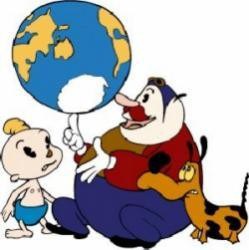
Welcome to a new segment of Twinsanity called The Couch, in which we unearth some of the the most unique, obscure and in some cases downright odd shows which many people have long forgotten (or just plain didn’t know about in the first place), but which we thought were kind of good, fun or at least had potential. Basically the flip side of The Retro Bin. Today, we’ll be looking at a forgotten toon titled Les Kikekoi, or as we Yanks called it, Saban’s The Why Why Family.
The Why Why Family was a French-produced animated children’s series which originally aired in syndication in 1996, written by Annabelle Perrichon and François-Emmanuel Porché and produced by Saban Entertainment and CineGroupe. Later, in 1998, the show was broadcast in the United States by Fox. I personally only saw a single episode of this during its’ initial run; I had to catch the rest of the series on YouTube. It centered on a family unit who all lived in a bizarro hodgepodge house which was a mishmash of several different structures, sporting an astronomical observatory, a rocket hangar, a greenhouse, a giant microscope, a zigzag slide and several platforms.
I hear the architect who designed the Why Why home used it as a prototype for Pee-Wee’s Playhouse.
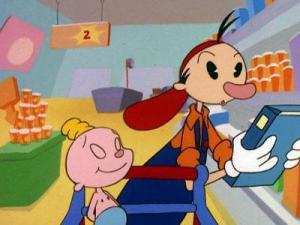
The plot was simpler than ABC: in each segment, the lone child of the family, one towheaded toddler named Baby Victor, would pose a question inquiring how a particular thing worked, then another respective family member would proceed to explain it in a fun, quirky way. There were 5 segments per show. Laugh, learn, wash, rinse, repeat. The Why Whys themselves were a unique and eclectic bunch, with each adult member specializing in a specific science, field of learning or expertise. Why Why-Keteer Roll Call:
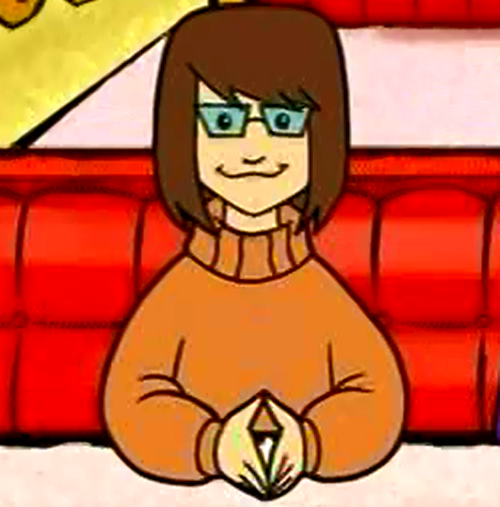
MILF, er, um, I mean Mom Vanilla with Birds Kwik and Kwak: Botany and Zoology (aka Flora and Fauna for you laymen)
Dad Max: Technology and Electronics (curiously, Max was the only family member who ran through his segments without the aid of any partners, except for Victor, of course, or sidekick pets)
Grandma Eartha with shapeshifting polka-dotted dragon Basalt: Geography, Geology and Meteorology
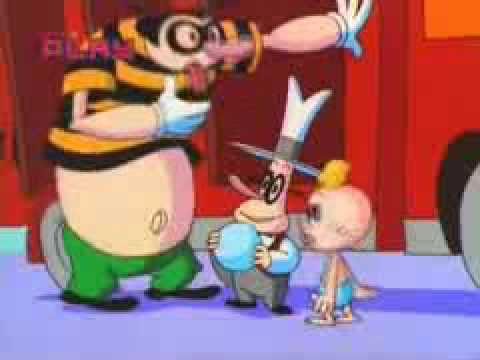
Uncles Micro and Scopo: Biology of the Human Body (FTR, Micro is the short dude in the 10-gallon hat, Scopo is the somewhat goony looking big lug in the Polo shirt with the Popeye forearms)
Zygo the dog and Grandpa Matik (together their names spell out the word ‘zygomatic’, because….clever??): Astronomy and the Universe.
The Why Why Family never went beyond 26 episodes, and in retrospect, it’s not hard to imagine why. For one thing, the show was syndicated; many of the local stations that carried it (including the ones in my area) aired the show insanely early in the mornings opposite the Farm Report.
“Well shucks, why would yew wanna sit in front o’ that there teevee box when yew could watch corn a-growin’?”
For another, the show aired back in 1996. In the late 90’s most cartoons had to be “edgy” and “extreme to the Max”….
“DUUUUUDE! The toons of the 90’s were righteous to the extreme! BUST IT!”
…And The Why Why Family was neither of those things. The show wasn’t ‘hip’ or ‘cool’ by any stretch, in fact, it was almost radically square. There were no hip teenagers on the show: except for Victor, the family members were all adults with various degrees of learning, 2 of them elderly adults. The series’ art style was also notably retro: the cast resembled 1930’s cartoon characters (only in color), with Mickey Mouse style white gloves and Pac-Man dot eyes, and conventions like talking animals and inanimate objects suddenly coming to life with no explanation of why or how. The show’s style was also not edgy or extreme, leaning strongly towards gentle slapstick, squash-and-stretch physics (characters could get flattened like pancakes and just reform themselves an instant later without a scratch), corny retrofied music, groan-inducing puns and silly sound effects. Each characters’ segments were book-ended by individual title cards (ex: So-And-So Character in “Such-And-Such Pun-Filled Title”) and even “The End” title cards, something you almost never see on cartoons these days.
While The Why Why Family was a bit corny (OK, a lot corny), at the same time, I can’t bring myself to dislike this show. Having revisited this show, I actually enjoy it in an odd way. It was silly, but a fun and harmless kind of silly. I did think it was kind of cool how each character represented a particular field of science and learning (science geek here), I loved that kooky house of theirs, and I must admit to having a bit of a mom-crush on Vanilla at the time; with her big blond hair and midriff top, she looked like a NASCAR racer’s trophy wife. Plus, one of their pets was a fracking dragon. A talking, shape-changing flipping DRAGON. I just can’t hate on a show with that. I kind of wanted to have seen a side episode which showed what these guys did when they weren’t doling out lessons; oh well, there’s always fan-fiction.
So here’s to you, Why Why Family. One things for sure: in a time where most cartoons were assembly-line carbon copies of one another, The Why Why Family was a red-blooded original.
You must be logged in to post a comment.