I first read about this on Toon Zone, then again on Hobbyfan’s blog, Saturday Morning Archives.
Broadcast Partners has announced the triumphant return of Saturday Morning Cartoons…sort of…in the form of a syndication block.
Yeah, you might want to hold off on the Happy Dance until you get all the details. First, this 2 hour block will consist of the following 4 shows:
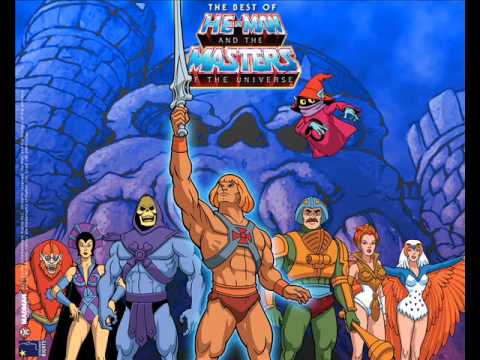
He-Man and the Masters of the Universe. Yes, the same series from 1983 to 1986 produced by Filmation, which is gradually being phased out by Me-TV…
Casper’s Scare School, the latest series starring the lovably wimpy ghost, which CN got tired of in recent years…
George of the Jungle, not the Jay Ward original, but rather the Flash animated remake by Teletoon which aired on CN back around 2007-2008….
…And The New Adventures of Lassie, a 2014 toon which is the first new Lassie series in over 40 years. Here’s a trailer for the latter.
“Uhh…..yay?”
But wait, there’s more! This block is slated to air from….5 AM to 7AM.
M’kay, I think it’s now time for a little Reality Check.
Let’s be real here: no kid (or adult, for that matter) is going to get up with the chickens at 5 AM to watch any of these shows. He-Man is always good fun 80’s cheese, but I’m not getting up at 5 to watch it. I was one of the few people who didn’t hate that new George of the Jungle toon, but it’s not worth getting up at 5 AM to see. I wasn’t rushing home to look at Casper’s Scare School when CN was carrying it in the afternoon, and The New Adventures of Lassie just looks very generic, though I admit some of the character designs are nice.
This block faces an uphill battle; in addition to airing at an insanely early time, this block is syndicated when the syndication market is all but dead in this country (most syndicated venues which aren’t news shows, infotainment shows or court shows go to cable and satellite channels), add to that how none of these shows have any real E/I content, which will only serve to make this block a harder sell; of course He-Man has its’ little Aesops tacked on to the ends of each episode and Lassie probably has little nature facts and stuff, so the E/I label could be slapped onto those shows.
This has all the appearances of folks trying desperately to keep the Saturday Morning Cartoon block alive in some, any, way, shape or form. To that I say: I appreciate the effort, but it’s time to face the hard truth:
SatAM was a big part of a lot of peoples’ childhoods; heck, I’ll readily admit it was a HUGE part of mine: I was so into SatAM cartoons as a kid that I would often camp out in front of our TV in the living room in my sleeping bag on Friday nights. But that was before cable, satellite, the internet, video games with online multiplayer options,On-Demand, Blu-Ray or even VCRs. The hard truth is that the Saturday Morning broadcast TV block has been rendered obsolete; some people are only still trying to keep it around because of nostalgia. This block is syndicated, so it’s possible that some local station could air it later in the day or even on Sunday mornings, or maybe, maybe some cable station could pick it up and run it during a more desirable time slot, but today’s kids with their gadgets and doo-dads and wacky critter hats would rather wait until these shows go online and will stream them legally or watch them not-so-legally, if they show any interest in them at all. So while I applaud the attempt by Broadcast Partners to Keep Hope Alive, the statistical likelihood is that the end result of this will be…
NOTE: you must be over 40 years old or a classic TV buff to know what the flaming heck we’re taking about here.
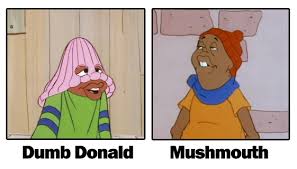
The character on the left is Dumb Donald from Fat Albert and the Cosby Kids. He’s the Cosby Kid known for being as smart as a bag of rocks and wearing a ski cap over his head, presumably hiding a horrible disfigurement or premature baldness, or maybe just the total absence of a face altogether.
The character on the right is Mushmouth, also from Fat Albert. His chief claim to fame is that he spoke in a hee-larious (in the days preceding Political Correctness) speech impediment, putting “buh”s after each syllable.
“Pretty different, really. Not really the same thing at all, is it?? IS IT?!?
You’d be surprised, actually. Fat Albert and the Cosby Kids, which ran on CBS on Saturday mornings from September 9, 1972 to September 1, 1984 and then in syndication until August of 1985, was a wildly popular show among the Generation X crowd; the cartoon was so popular, in fact, that according to Tim and Greg Burke’s book Saturday Morning Fever (if you don’t own this book, you should; it’s a great read) a fan at one time wrote and performed his own twisted episodes of the show for his college drama group, boasting such titles as “It’s Not Cool to Mess with Satanic Ritual” and “Weird Harold Gets AIDS”.
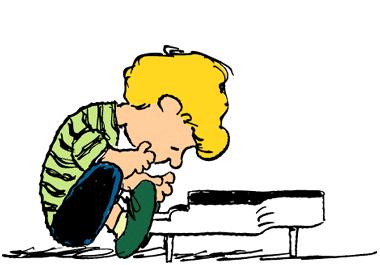
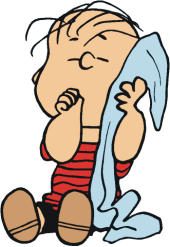
Yet somehow, many of our collective wires have gotten crossed over the years. For some reason, fans of the show frequently tend to remember the character of Dumb Donald as Mushmouth, like they’ll spot your bitchin’ Dumb Donald tramp stamp and then start talking like Mushmouth, for example. It’s like how many folks who remember Charles Schulz’s Peanuts seem to confuse the character of Schroeder for Linus, possibly since both characters wore shirts with horizontal stripes on them and both characters spent a lot of time with Lucy, though in the case of both characters, it wasn’t by choice.
Schroeder: Blond hair. Plays the piano. Digs Beethoven.
Linus: stringy hair. Addicted to security blanket.
Know the difference.
*******************
Getting back to Dumb Donald and Mushmouth, there have 3 notable examples in popular media where these 2 characters have been confused for one another:
On an episode of Saturday Night Live hosted by Susan Dey, then riding high on her role on L.A. Law, not surprisingly, there were numerous jokes and allusions to the show where Dey got her start, The Partridge Family, throughout the broadcast, culminating in a sketch in which she reprised her role of Laurie Partridge to partake in a battle of the bands with the Brady Kids, led by Jan (played of course by then cast member Melanie Hustell, famous for her dead-on Jan Brady impression). In the sketch, the battle got quite heated, with the characters throwing barbs at one another (Bradys: “Go cryin’ to Mama! You guys don’t have a Daddy!”, Partridges: “Well, you’re all half-adopted! What’s really going on over there??”), until things were broken up by then cast member Chris Rock, who rushed on stage wearing a Dumb Donald costume, hat and all, but speaks like Mushmouth: “At-buh least-buh you can talk-buh plain-buh!” Dana Carvey (as Keith Partridge) even acknowledges Chris’ character as “Mushmouth from Fat Albert and the Cosby Kids“. Shame on you, SNL writers, you call yourself children of 70’s TV, and somehow that blunder made it to the air? No one put on the brakes?? Thankfully, the show made up for that faux pas a few seasons later in a later episode hosted by Bill Paxton, which featured a VH-1 Behind the Music parody of the gang’s Junkyard Band; here in separate vignettes, then cast member Tim Meadows played both Donald and Mushmouth, and this time they got the names and costumes correct. (Granted, Dumb Donald was depicted as having a drug-induced meltdown while wielding a pistol in a seedy hotel, and Mushmouth had served a dime in prison where he converted to Islam and changed his name to ‘Mustafa Mushmouth’ after discovering “A-buh-llah” in the joint, but hey, at least they got the characters’ identities right this time.)
In the South Park episode “Treehouses”, there’s a running gag of the character Stan watching a spoof of Fat Albert called Fat Abbot. Abbot, of course, is foul-mouthed, ill-tempered and violent, prone to telling people off and threatening to bust a cap in their asses, once even threatening to blow Rudy the Rich Kid away after Rudy questions his accusing him of being “like school in summertime”, a popular Fat Albert crack meaning you have “no class”. He is backed up by a Dumb Donald lookalike character, who again speaks like Mushmouth: “I’ll-buh pop-buh a cap-buh in yo’ ass-buh too-buh. Bitch-buh.”
In an episode of NBC’s NewsRadio, there was sub-plot in which quirky secretary Beth (played by Vicki Lewis) was attempting to make some cash on the side by designing and selling her own line of Dumb Donald hats. A running gag in the episode was that everyone who saw the hats would call them “Mushmouth hats” and Beth would have to correct them. “It’s a Dumb Donald hat!”
To add insult to infamy, for a while during the last years of the USA Network’s airing cartoons during the day, for a time Fat Albert ran on USA just after the USA Cartoon Express (I’m guessing the reason Fat Albert was never actually part of the Cartoon Express was because it had pro-social values and an edutainment factor, so USA didn’t want to lump it in with their other shows, either that or the Cos paid them big time to give his show special treatment), and in one promo for the show, a voice-over speaking in a less-than-stellar Bill Cosby impersonation referred to Dumb Donald as ‘Weird Harold’.
Mark this day on your calendars, for you’re about to witness something historic: we’re about to dig into the first Retro Bin entry that’s not about a Hanna-Barbera cartoon! It’s not that we have a grudge against HB, it’s just that the Retro Boxes typically cover toons from the 70’s through 90’s, and HB produced a lot of stuff during that era, so there’s a lot of that studio’s shows to cover. But we don’t just riff on Hanna-Barbera’s retro-cheese, we’re equal opportunity wise-crackers. Now, on with the review:
Today we’ll be looking at Jim Henson’s Little Muppet Monsters, an extremely short-lived live-action/puppet/animation hybrid series which ran briefly on CBS. If you don’t remember this show, that’s hardly surprising; Little Muppet Monsters is one of those shows that takes longer to talk about than it actually ran, which was for exactly 3 weeks from September 14 to September 28, 1985.
First, a little history is required: in order to review Little Muppet Monsters, one must first familiarize ourselves with CBS SatAM at that time. Into the WABAC machine….
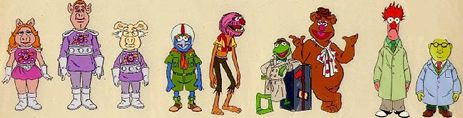
The year was 1985. CBS was riding high on the success of their Saturday morning cartoon series Jim Henson’s Muppet Babies, which was itself based on a brief but highly popular musical fantasy sequence from the film The Muppets Take Manhattan, released a year earlier in 1984, in which Miss Piggy poses the hypothetical question of what it might have been like if the Muppet Show gang had known each other when they were little. Muppet Babies was therefore based entirely in un-reality, which is good because if one were to ever stop and ponder the show in any kind of canonical fashion, it would only raise a ton of puzzling unanswerable questions, such as: why, if only 2 of the Muppet Babies, Scooter and Skeeter, were related, did they all live together in the same house? And where were their parents? Nanny (voiced by Barbara “June Cleaver” Billingsley) was clearly just a domestic and not the owner of the place. So just where and what was this house with no master where the Muppets lived? (It might have been more plausible if the producers had made the house a nursery school or a day care center.) And speaking of Scooter, why was he even there? On The Muppet Show, Scooter was just a kid while the other characters were adults, so logically, neither he nor Kermit’s nephew Robin should have been on MB at all, as realistically they weren’t even gleams in their moms’ eyes during that time. And what was the deal with Bunsen and Beaker? They didn’t live with the other Babies; they just occasionally visited, so where did they live, and who was in charge of them? And why and how does a baby (albeit a baby scientist) have a baby assistant? How does that work? Or perhaps Bunsen and Beaker were/are brothers? And why was Baby Piggy still macking on Baby Kermit? If we’re supposed to believe that for this series, Kermit and Piggy grew up together and were raised together in the same house no less, then they should feel more like brother and sister. And what was up with Animal? Since when was he “younger” than the others, like they tried to established on the show? I suppose they just needed a reason to explain why he was the way he was, i.e., more feral and animal-like than the actual animals on the show. I had always suspected that his behavior was due to years of living the hardcore rock-and-roll lifestyle, months on the road, wild parties, alleged sex with groupies and years of being fried had simply taken their toll on him. There I go over-thinking things again. Muppet Babies is just one of those shows where it’s best to check your brain at the door and simply roll with it, as any hint of logic would’ve killed the entire series.
-Incidentally, I know I haven’t said much about Little Muppet Monsters yet, but given the show’s lifetime was so brief, there really isn’t much to say about it other than “It happened”. Anywho, Muppet Babies was a huge ratings hit; it did so well in its’ first season that CBS wanted to expand the show to an hour, thus Team Henson created a second show to fill out an additional half-hour; the combined venture was called Jim Henson’s Muppets, Babies and Monsters.
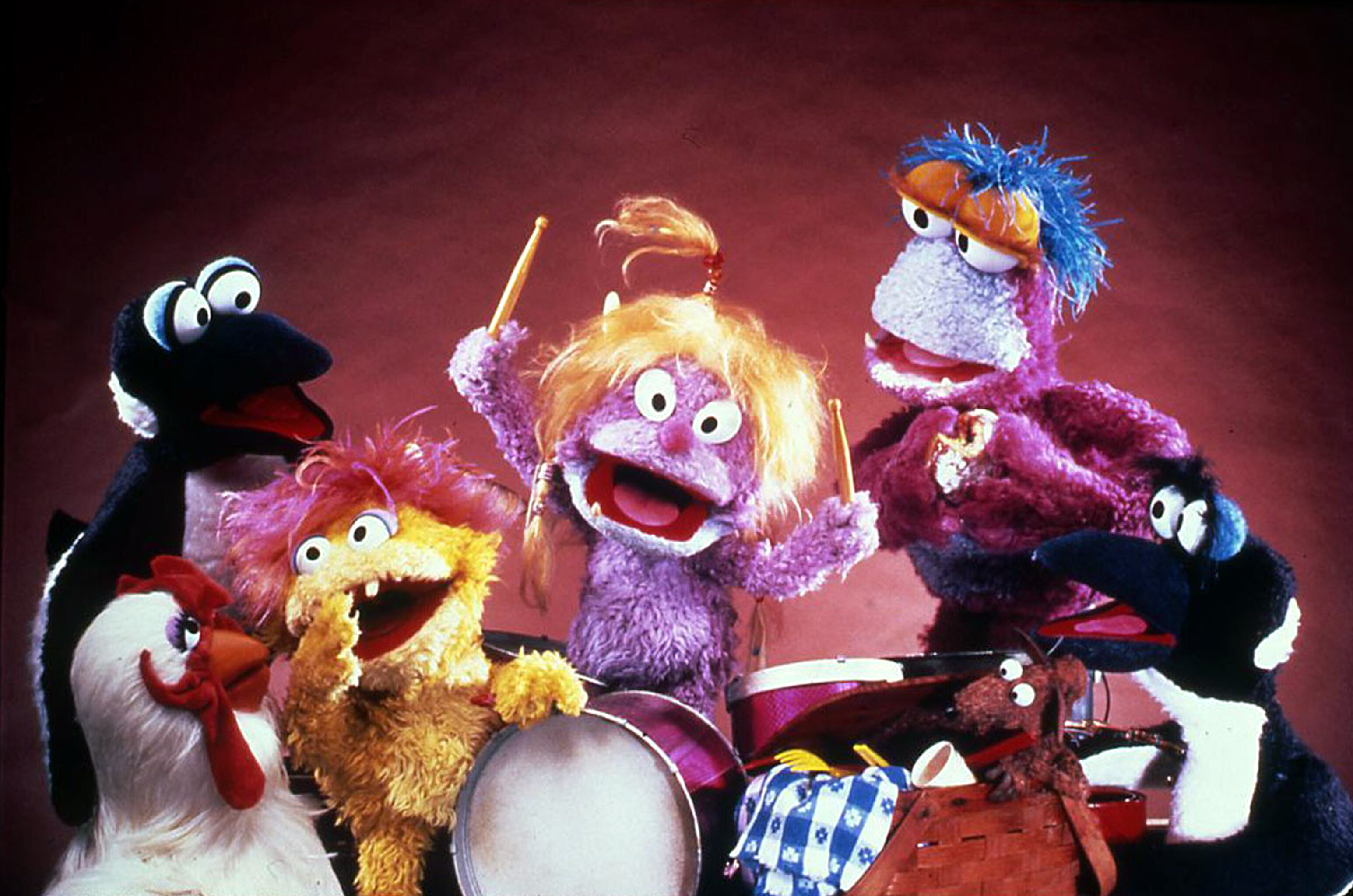
“The concept of this second half-hour was neither simple nor particularly well-developed,” according to storyboard director Scott Shaw. LMM focused on a trio of live-action (Muppet) monster kids named Tug, Boo and Molly. The 3 offered little in the way of characterization, as the series wasn’t around long enough for any of them to establish any solid identities. Tug and Boo were brothers and Molly was the token girl, but beyond that there wasn’t much to say about them. The show’s premise was that the trio had started their own TV station from the basement of the adult Muppets’ home (so wait, all of the Muppets live together in one house? Was this the same continuity as Muppets from Space?) which broadcasts only to the TV sets in the house upstairs, after an incident where Scooter has them put in the basement after Molly and Boo played water polo in the living room. (Again, huh? Since when is Scooter any kind of authority figure? It’s amazing how even Henson studio tends to forget that Scooter’s just a kid.) The kids were joined by Nicky Napoleon and his Emperor Penguins as their music act/house band.
The ‘shows’ broadcast on this quasi TV station were mostly recycled segments from The Muppet Show, only in animated form (CBS must’ve figured if kids will watch animated Muppet Babies, they’ll watch animated Muppet everything else), such as “Pigs in Space”, “Muppet Sport Shorts” featuring Animal for some reason (the dude’s a rocker, not a jock), “Fozzie’s Comedy Corner” in which a live-action Fozzie Bear tells variations on the “Why did the chicken cross the road?” joke as an animated stick-figure chicken does strange things on-screen, “Gonzo’s Freaky Facts and Oddball Achievements,” pretty much the same basic idea as “Comedy Corner” only with Gonzo acting as host instead of Fozzie and the emphasis being on weirdness rather than jokes. The final segment of each show was “Kermit the Frog: Private Eye”, allegedly film noir parodies starring Kermit as a Sam Spade-esque detective and Fozzie as his assistant, but they would usually drift away from this go off on some irrelevant tangent; the stories typically rambled and faltered and rarely came to any logical conclusion. As with the show as a whole, one really couldn’t say anything about the segments beyond, “OK, so that happened.”
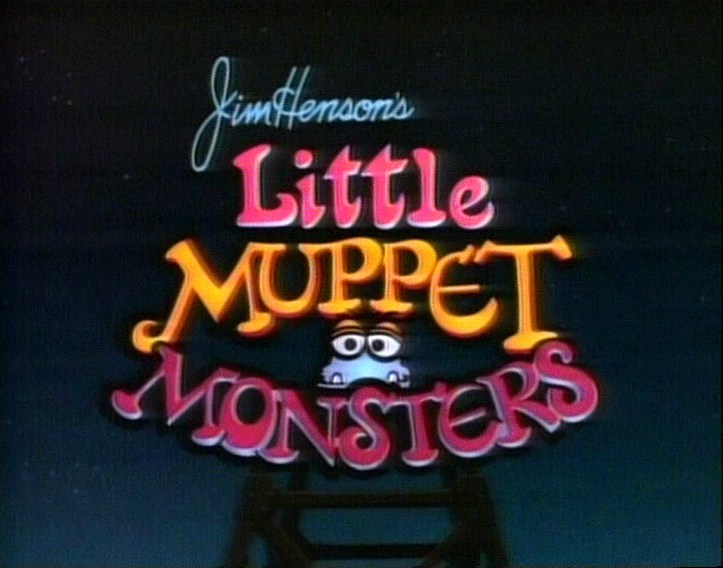
As per tradition, here’s the show’s opening:
Of the thirteen episodes that were produced, only three of them ever aired (and some of the remaining 10 epsiodes were incomplete at the time of cancellation). Ironically, it was Jim Henson himself who decided to pull the plug; Henson Associates and CBS agreed that the concept had never been properly thought out and just wasn’t up to Henson’s high standards. A quote from the man himself:
“I’ve always felt that the juxtapositioning of live-action and animated Muppets invited an unfavorable comparison, to which the cartoon version inevitably suffered; the puppetry was just too good. The combination of Muppet babies, adults and kid monsters was very disorienting. Also, due to a lack of development time, the concept — and therefore, the writing and designs — never quite jelled.” The now-vacant second half-hour was filled with repeats from Muppet Babies‘ 1st season. The ratings stayed strong, and everyone was happy. The only traces of LMM’s existence was the 6-note bridge from the LMM theme song, which remained part of Muppet Babies‘ closing title sequence throughout the remainder of the show’s run as well as syndication. Also, in another of TV’s great ironies, in 1990, segments of the animated “Pigs in Space” and “Kermit the Frog, Private Eye” from the second episode of Little Muppet Monsters titled “Space Cowboys” were re-shown in the final episode of Muppet Babies titled “Eight Flags Over the Nursery”.
Today, Little Muppet Monsters is no more. The series has yet to turn up on DVD, and given that most people have either forgotten about LMM or simply had no idea that it ever existed at all, it’s unlikely that it ever will. Some of the puppet models for the Monster characters have since been re-used for other purposes:
Boo Monster appears in The Jim Henson Hour episode “Science Fiction.” He is seen as an audience member of the “Miss Galaxy” pageant.
Boo Monster appears in The Cosby Show episode “Cliff’s Nightmare.”
Tug Monster made a background cameo in the opening of The Muppets at Walt Disney World.
The puppet for Tug Monster was later seen in Nick Jr.’s Muppet Time as Do Re Mi Monster and was later seen as different customers in Mopatop’s Shop.
Finally, in yet another great irony, all 3 central characters: Tug Monster, Molly Monster, and Boo Monster were seen briefly in the special The Muppets: A Celebration of 30 Years, which was broadcast on January 21, 1986. The special was shot before the suggestion was made to take Little Muppet Monsters off the air, so the show cheerfully celebrated the Muppets’ latest production and the newest additions to the Muppet family—even though that production had been canceled four months earlier.
In this installment of The Retro Bin, we’ll be looking back at the NBC Saturday morning series produced by Hanna-Barbera studios, Yogi’s Space Race.
Wow. That title logo font is so original. Never saw that anywhere before.
When George Lucas’ motion picture Star Wars became a monster hit at the box office in 1977, each of the 3 networks (this was before the creation of the FOX network, by the way) tried to come to come up with their own TV version. There was Space Academy and Jason of Star Command on CBS, Space 1999 and Battlestar Galactica on ABC and Buck Rogers in the 25th Century on NBC. Not surprisingly, Star Wars Mania also found it’s way into the world of SatAM cartoons. NBC’s Yogi’s Space Race was one of several of the alphabet network’s attempts to bring Star Wars to the small screen. The series was another H-B “potpourri” series bringing together established H-B stars such Yogi Bear and Huckleberry Hound along with new characters in order to compete with each other in a good natured competition. Basically, it was Wacky Races in space. One can imagine how the board meeting that lead to this shows’ creation might have went:
HB Executive #1: We’ve got to come up with a new show to cash in on this Star Wars heat! Anybody got any ideas?
HB Executive #2: Hey, remember that cartoon that we did back in 1965? The Wacky Races? Well, why don’t we just do that again, but in space?
HB Executive #3: Yeah! And let’s stick some established character in there so kids’ll want to watch it! Since we use Scooby Doo, Yogi Bear and The Flintstones for everything, let’s use 1 of them. Like, say….(throws a dart at a dart board with pictures of old H-B characters taped on it). Yogi Bear! We can call it “Star Race”!
HB Executive #2: No, too obvious! Let’s call it Yogi’s Space Race!
HB Executive #1: BRILLIANT! Let’s get to work on that!
Yogi’s Space Race originally ran for 90 minutes, with the Space Race segments sandwiched between 3 added attractions; The Galaxy Goof Ups (which featured 4 of the Space Race characters as Galactic Patrol officers whose missions mostly involved using their stupendous incompetence to give their superior officer daily migraines), as well as 2 non-space themed attractions, The Buford Files and The Galloping Ghost. Buford was basically a bucolic version of Scooby Doo, while Galloping Ghost focused on 2 women who worked at a dude ranch which was also haunted by the ghost of the Miner 49er. Think Hey, Dude with a specter. Neither of these series ran for very long, and in the case of each, if you’ve seen 1 episode, you’ve seen them all, so sorry, folks, I’m not motivated enough to do a full review of either. Galaxy Goof-Ups was later spun off into it’s own separate series, aptly titled Galaxy Goof-Ups, reducing the series to 60 minutes. It was then reduced to only a half hour in early 1979 when NBC spun off Buford and The Galloping Ghost to a single series, imaginatively titled Buford and the Galloping Ghost, so in the end, the Space Race segments ran by themselves. Anyways, here’s the shows’ intro.
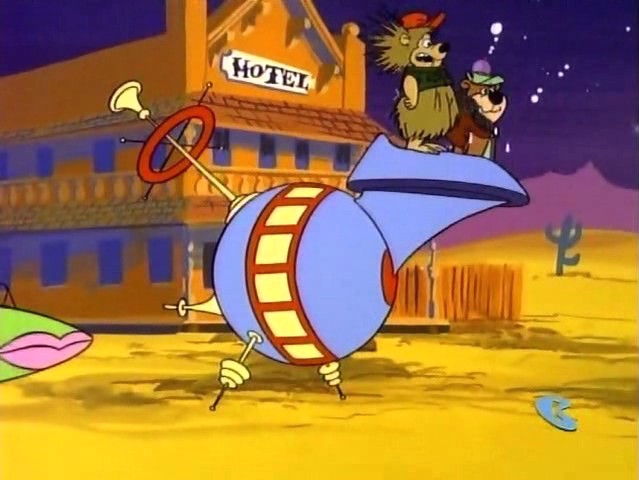
The Space Race segments focused on weekly intergalactic racing competitions in which the competitors flew around in mini space cruisers. The individual teams consisted of:
Yogi Bear and Scare Bear (a cowardly bear voiced by Stooge replacement Joe Besser who also starred on Galaxy Goof-Ups). That’s right, no Boo-Boo this time. He was offered the job, but he declined.
Yogi: Hey, Boo-Boo! NBC wants us to star in a new show where we race and have adventures in outer space!
Boo-Boo: That’s sounds kind of stupid, Yogi. I think I’ll pass on this one.
Yogi: But, Boob, it says that every week we get to dance in a space disco!
Boo-Boo: It’s 1978, Yogi. Disco is practically dead! Besides, you know that I prefer Rockabilly!
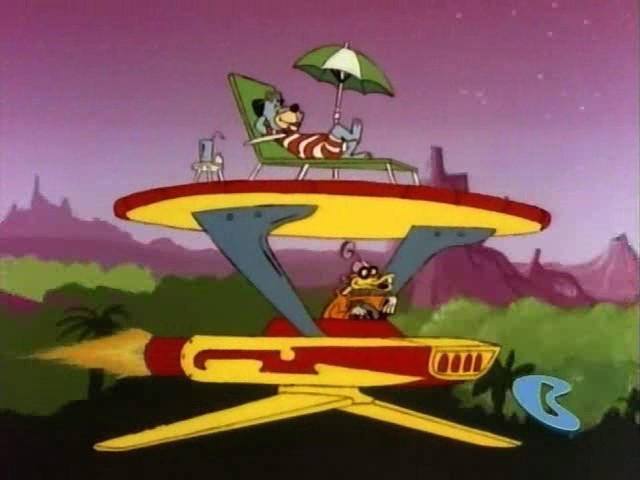
Huckelberry Hound and Quack-Up (another new character who also starred with Huck, Yogi and Scare Bear on Galaxy Goof-Ups, who here acted as the zany, clumsy pilot of the ship)
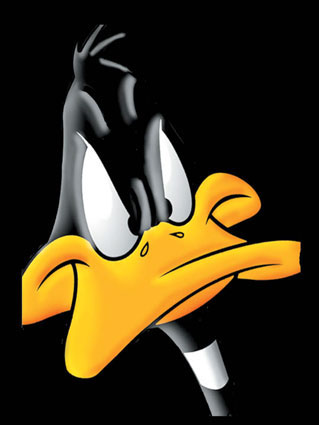
“Oh, a crazy cartoon duck. Real original, Hanna-Barbera! I wonder where you got that idea from!”
*************************************
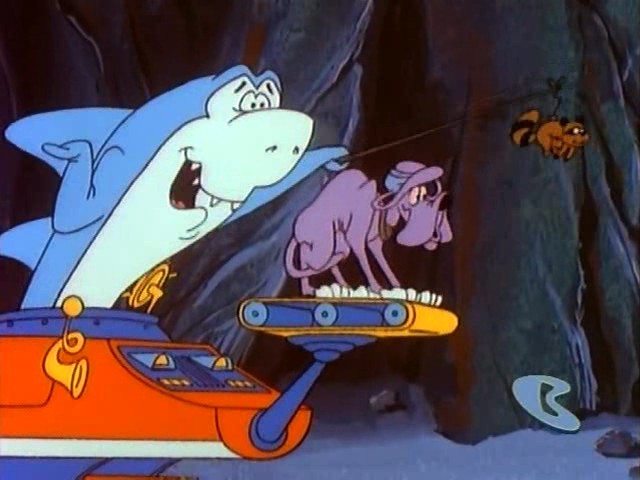
Jabberjaw and Buford (from the aforementioned Buford Files) – Jabberjaw, the shark with the Curly Howard sound-like voice, flew the ship, while Buford ran outside of it on a treadmill to give the ship additional speed.
Wendy, Rita and Nugget Nose (the central characters from Galloping Ghost)
From this…
…To this. Transformers. Creepos in Disguise.
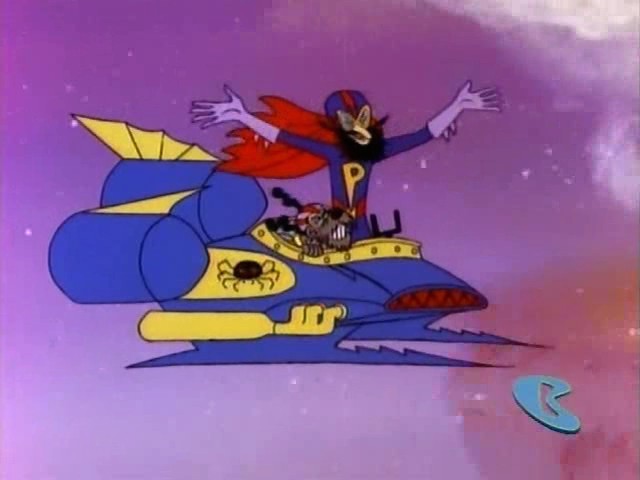
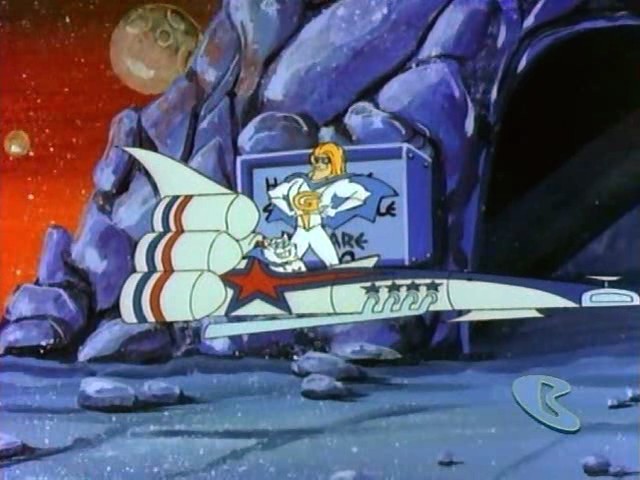
Phantom Phink and Sinister Sludge/Captain Good and Klean Kat – A space villain bad guy and his sneaky dog who also disguised themselves as Captain Good (Phink), the heroic champion and the paragon of good sportsmanship and his sidekick Klean Kat (Sludge). No one on the show (except for us, the viewers) knew that Phantom Phink/Captain Good and Sinister Sludge/Klean Kat were one and the same. Why they did this was never explained. Either Phink and Sludge had serious split personality disorders or maybe they owed Jabba the Hut a huge debt.
In fact, there were a number of things that weren’t explained on the show, such as how did Yogi, Huck and Jabberjaw get to outer space in the 1st place? And what were they doing there? How did Huck recline on his spaceship patio without him floating off into the abyss of the cosmos? And is a outer deck patio on a spaceship really a good idea for a race where the object is to go fast? And how was it that all of the racers were able to breathe when there’s no oxygen in space, yet none of the space ships that they flew in had tops? I tend to think that perhaps each of the ships had some kind of device that surrounded each them with a packet of artificial oxygen which allowed them to breathe in the vacuum of deep space, or possibly…
Dang! There I go over thinking a kids’ cartoon show again! Sorry about that. Anyway, just like it’s spiritual ancestor, Wacky Races, the individual episodes mostly ran together. Most people who are old enough to remember the series just remember the overview of the series in general, rather than any individual plots or story lines. Same deal with Galaxy Goof-Ups. I actually didn’t see any episodes of Galaxy Goof-Ups until they were rerun on Nickelodeon, and even after that, I don’t remember much except that at least once in each episode the title quartet would be shown boogeying down at an intergalactic disco, which of course was in no way inspired by the Cantina scene in Star Wars. I leave you now with images of disco music…IN SPACE!!
(No, this isn’t the actual music that was used on the show. I couldn’t find a clip with the actual show’s music, but you get the idea.)
Hello and welcome to a new segment on Twinsanity titled The Retro Bin, where we unearth a forgotten show from Toon Town’s past, examine it and basically tear it a new one. Today, we’ll be looking at a Hanna-Barbera “classic” from 1979, The Super Globetrotters.
Look! Down on the court! Is it the 1992 Dream Team? Is it the NBA Hoop Troop?? NO! It’s the Super Globetrotters!!!
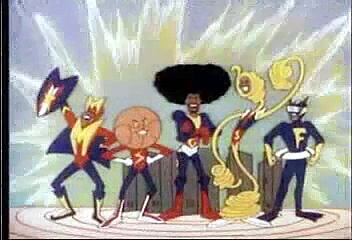
First, the obligatory history lesson: in 1970 the world-famous Jesters of Dunk were given a Saturday morning cartoon series from Hanna-Barbera Studios in which they would travel the world having wacky adventures. Not content to rest on their laurels, HB gave the Trotters another series, this time adding a new twist: figuring that just having the Harlem Globetrotters in a SatAM cartoon wasn’t enough, HB decided to take the concept one step further and make the Globies superheroes who transform into their super-selves by running into magic lockers. (We are not making this up.) The Trotters of Tomorrow were an eclectic bunch to say the least:
Nate Branch became Liquid Man, who could turn himself into water. One of Saturday morning’s greatest mysteries is that if Nate was called Liquid Man, then why did he wear an ‘F’ on his costume? That bugged the heck out of me as a kid.
Freddie “Curly” Neal became Super Sphere (aka Sphere Man), who could retract his limbs into his head to bounce, smash, and grow. Naturally, his head looked like a basketball.
Hubert “Geese” Ausbie became Multi-Man, who could clone himself into into a seemingly infinite amount of duplicates to surround and mystify foes. He also carried around a shield which he never seemed to have use of.
James “Twiggy” Sanders became Spaghetti Man, who possessed a body of living spaghetti which he could use his as a ladder, a rubber band or a rope.
Louis “Sweet Lou” Dunbar became Gizmo Man (sometimes just Gizmo), who had an immense Afro which was a gateway to Hammerspace, containing an unlimited supply of gadgets (including one that fit the current situation). Sweet Lou’s particular power was so nutty that it later turned up as a visual gag in an episode of Comedy Central’s Upright Citizens’ Brigade.
The team received their marching orders from the Crime Globe, a basketball-shaped satellite (voiced by Frank Welker) that would alert the Globetrotters of villainous activities and even give them strategies to fight them.
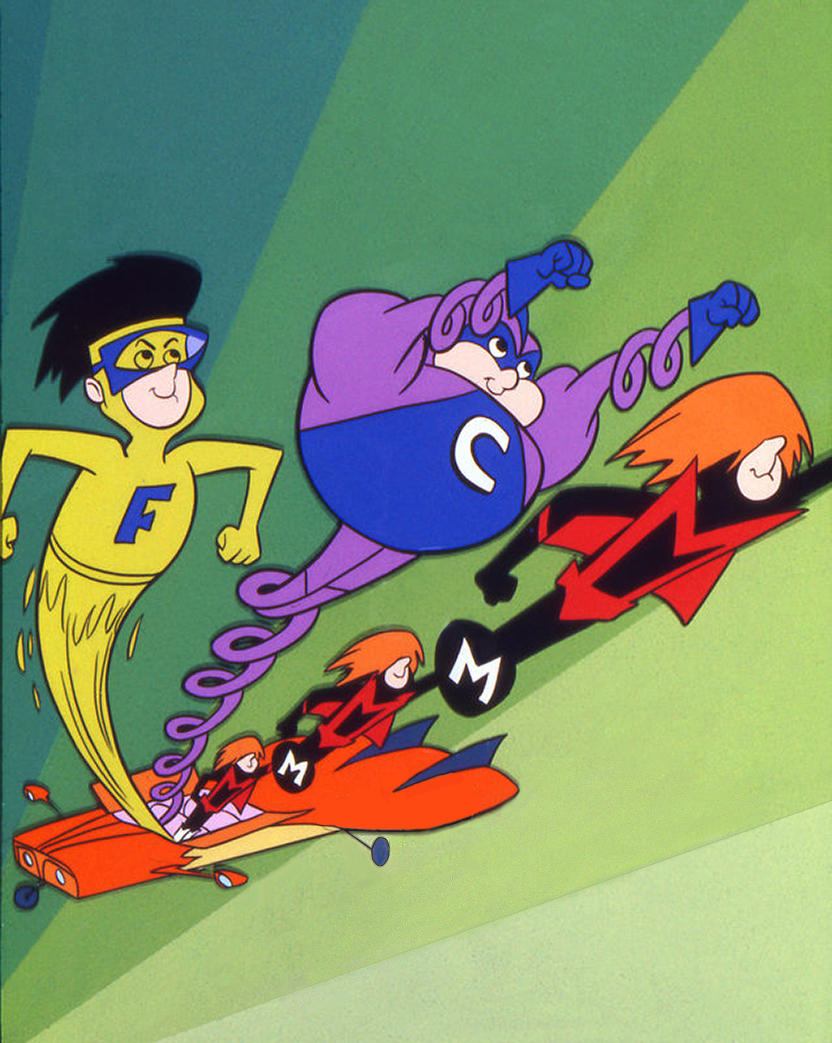
-Wait, an HB show about a team of superheroes featuring a guy who can turn into water, a guy who can create copies of himself and a guy who can spring and stretch. That sounds kind of familiar….
…Hanna-Barbera copying one of their own successful formulas? Nah, couldn’t be. They’ve never done that.
The actual episodes typically blurred together, so it’s not really necessary to go into great detail about them. This opening pretty much sums things up.
The stories were little by way of repetition: The Globetrotters would be playing some exhibition match somewhere when they’d get a message from the Crime Globe warning them that some nut-cake with a wacky-themed costume and gimmick was planning to unleash some diabolical plan of some sort, the Globies would go Super, then the Trotters and the villains of the week would after 15 minutes, shtick each other to a stalemate. Then the Villain of the Week would challenge the Globetrotters to a basketball game for whatever McGuffin they were squabbling over. Since they’re the Harlem Globetrotters, basketball is what they do, they would always accept, expecting a fair game. The villains would always cheat–because they’re villains–and the Globies would get their butts handed to them in the first half, then at halftime the Crime Globe would have to remind them that they’re, like, you know, SUPERHEROES and that they should go Super again and use their powers to beat them. They would, and they would come out triumphant. This happened in every episode. Every. Single. Episode. You’d think just once the Globetrotters would get the idea to become super at the start of the match, but no. I would have loved to have seen this exchange, just once:
Crime Globe: (at the start of the match) Attention, Globetrotters. Suit up and become the Super Globetrotters.
Nate: Why? It’s just a basketball game. We’re the Globetrotters. This’ll be a piece of sweet cake!
Crime Globe: Ah, no. Come on, guys, how many times have we done this? The bad guys are going to cheat and whoop your butts throughout the first half, then I’ll have to tell you that you can’t win this game as regular Globetrotters, then you’ll have to became superheroes to defeat them. So how about this time we skip all that and cut right to the chase??
Twiggy: Well yeah, that’s happened once or twice, but…
Crime Globe: It happens every week. What’s wrong with you?! It’s just like that time you guys met Snow White; you were playing against the Wicked Queen’s living gargoyles and of course the Queen used black magic to beat you, so at half time you finally got the bright idea that since you’re the flipping HARLEM GLOBETROTTERS, that you should be using your exhibition tricks to win, like you should have been doing at the beginning. So go super, now!
Curly: You sure? ’cause I think…
Crime Globe: GET IN THE @#$%ING LOCKERS ALREADY!!
After a single season, the Globies were handed a copyright lawsuit by a certain rock band/superhero trio and also received this letter from the Hall of Justice:
Dear Globetrotters, If you really want to save the world, stay on the courts and leave the super-heroics to the professionals. Back off our racket or we’ll make arrangements for you to have to start dragging around 2 annoying teenagers and a stupid dog in a cape. Signed, The Justice League And that put an end to the practice of basketball stars doubling as superheroes, at least until Shaquille O’Neal took the role of Steel. And we all saw how well that turned out.








 Twin Images
You must be logged in to post a comment.